 |
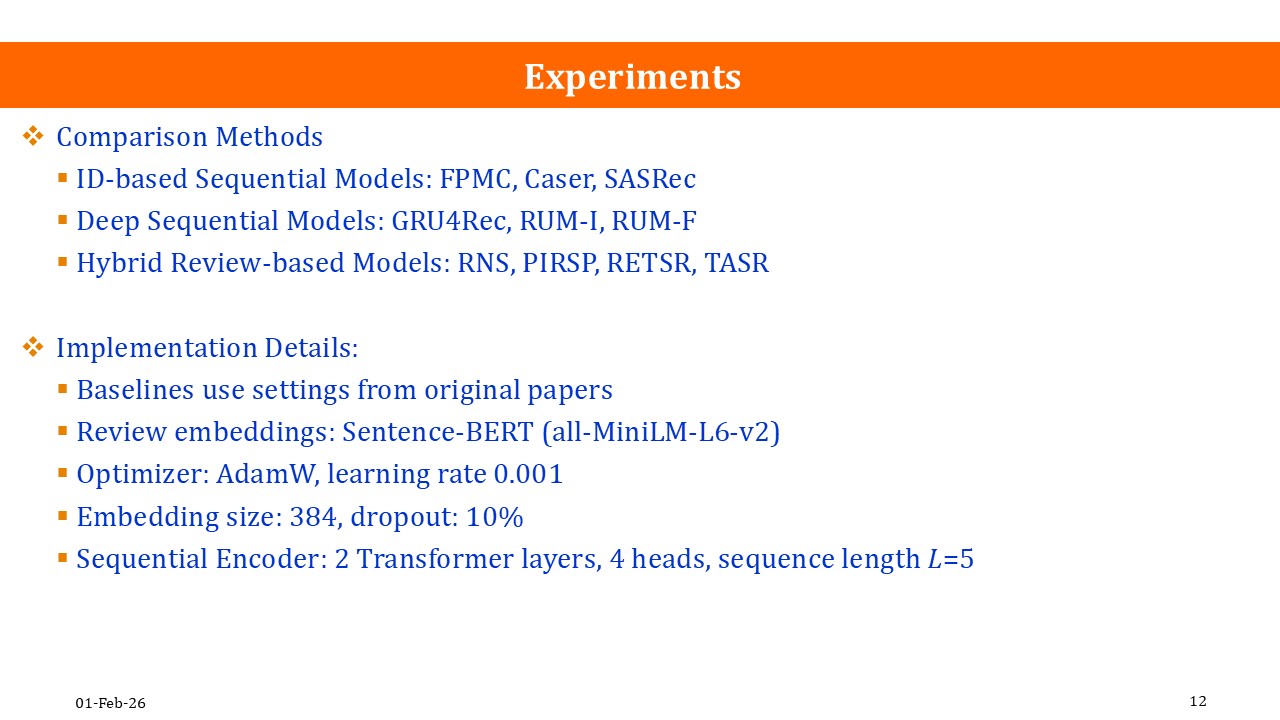
To evaluate the effectiveness of HiSeR, we compare it with representative baseline models from three major categories. First, ID-based sequential models, which rely solely on item interaction sequences, including FPMC, Caser, and SASRec. Second, deep sequential models, which employ deep neural architectures to encode user behavior, including GRU4Rec and RUM, with its two variants, RUM-I and RUM-F. Third, hybrid models incorporating review information, which combine interaction sequences with semantic signals from reviews, including RNS, PIRSP, RETSR, and TASR.
All baseline models use the parameter settings reported in their original papers. For HiSeR, review embeddings are generated using Sentence-BERT (all-MiniLM-L6-v2).�The model is optimized with AdamW, using a learning rate of 0.001, an embedding size of 384, and a dropout rate of 10%. To ensure fair comparison, the Sequential Encoder uses two Transformer layers, four attention heads, and a sequence length of L equals 5. |
 IEEE/ICACT20260275 Slide.12
[Big Slide]