 |
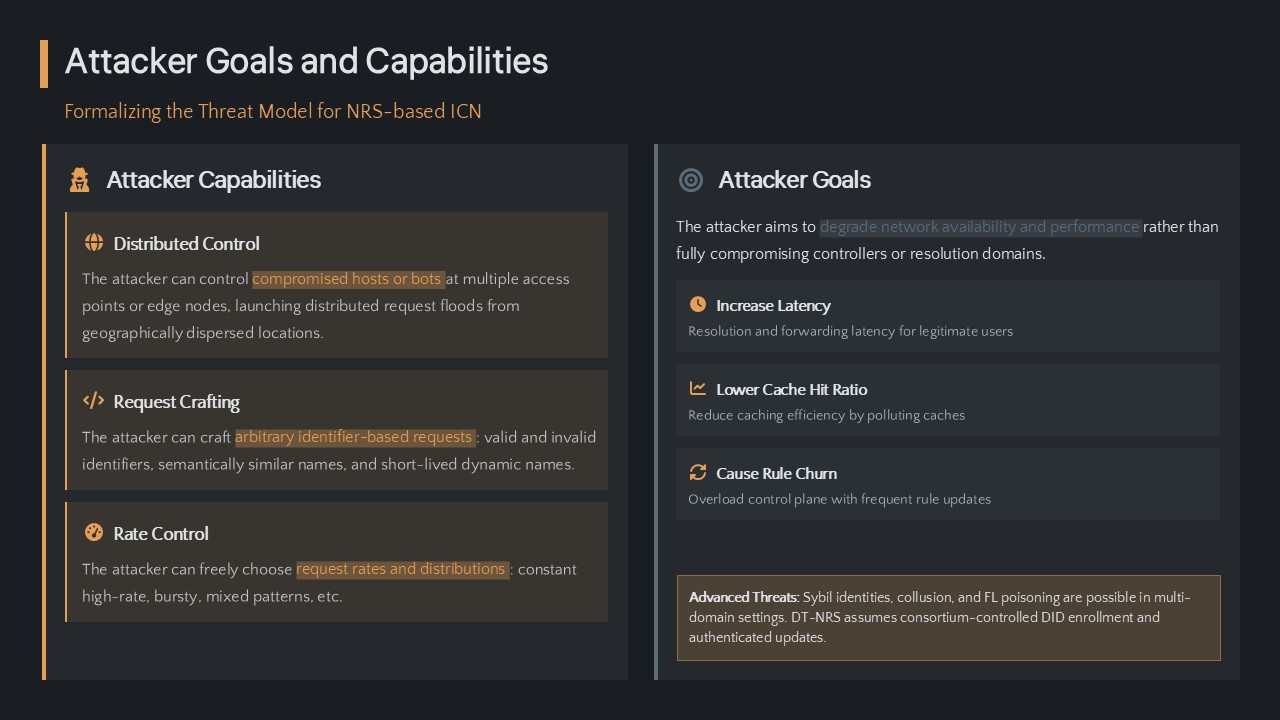
We assume the attacker can control compromised hosts at multiple access points or edge nodes, so the attack is distributed.
The attacker can craft arbitrary identifier-based requests, including valid and invalid identifiers, semantically similar names, and short-lived dynamic names, and can choose rates and distributions—high-rate, bursty, or mixed patterns.
The attackerĄ¯s goal is not necessarily to compromise the controller, but to degrade availability and performance: increase resolution and forwarding latency, lower cache hit ratio, and cause rule churn.
We also acknowledge advanced threats like Sybil identities, collusion, and federated learning poisoning. In this work, we assume consortium-controlled DID enrollment and authenticated updates, and we leave deeper study of those advanced threats to future work. |
 IEEE/ICACT20260343 Slide.12
[Big Slide]
[YouTube]