 |
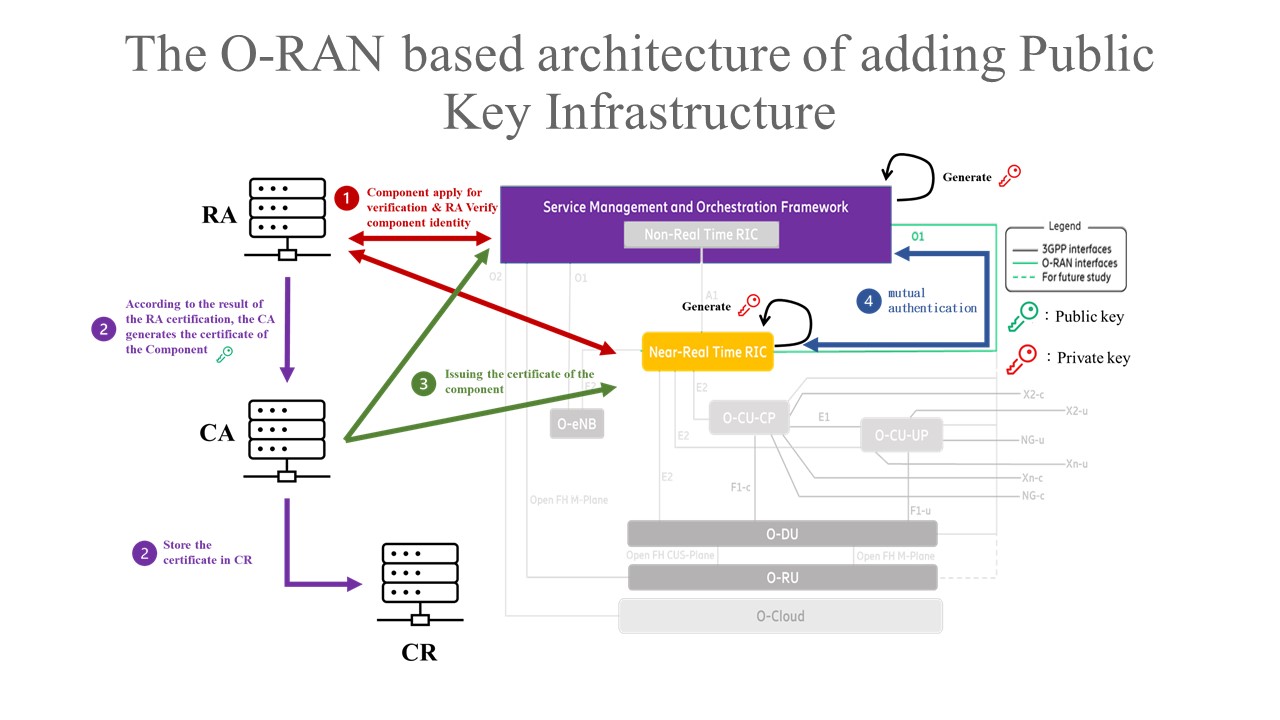
This study focuses on the security strategy required before an attack occurs and introduces the public key infrastructure architecture, which is composed of three main components: the certificate authority, registration authority, and certificate repository. Among them, the certificate authority is a trusted third party and is responsible for verifying the legitimacy of the public key in the public key system. First, the SMO and Near-RT RIC must register with the registration authority; subsequently, the registration authority will confirm the identities of the SMO and Near-RT RIC. After the confirmation is completed, the certificate authority signs the digital certificate to prove the authenticity of the public key, and then believes that the public key signed by it is valid and belongs to the SMO and Near-RT RIC; subsequently, it stores the public key in the certificate repository. Next, the certificate authority will issue a certificate to the applied SMO or Near-RT RIC. Finally, the two nodes possessing the certificate will conduct a two-way verification before commencing communication. The implementation framework is shown in Figure 4.
|
 IEEE/ICACT20220039 Slide.13
[Big Slide]
[YouTube]