 |
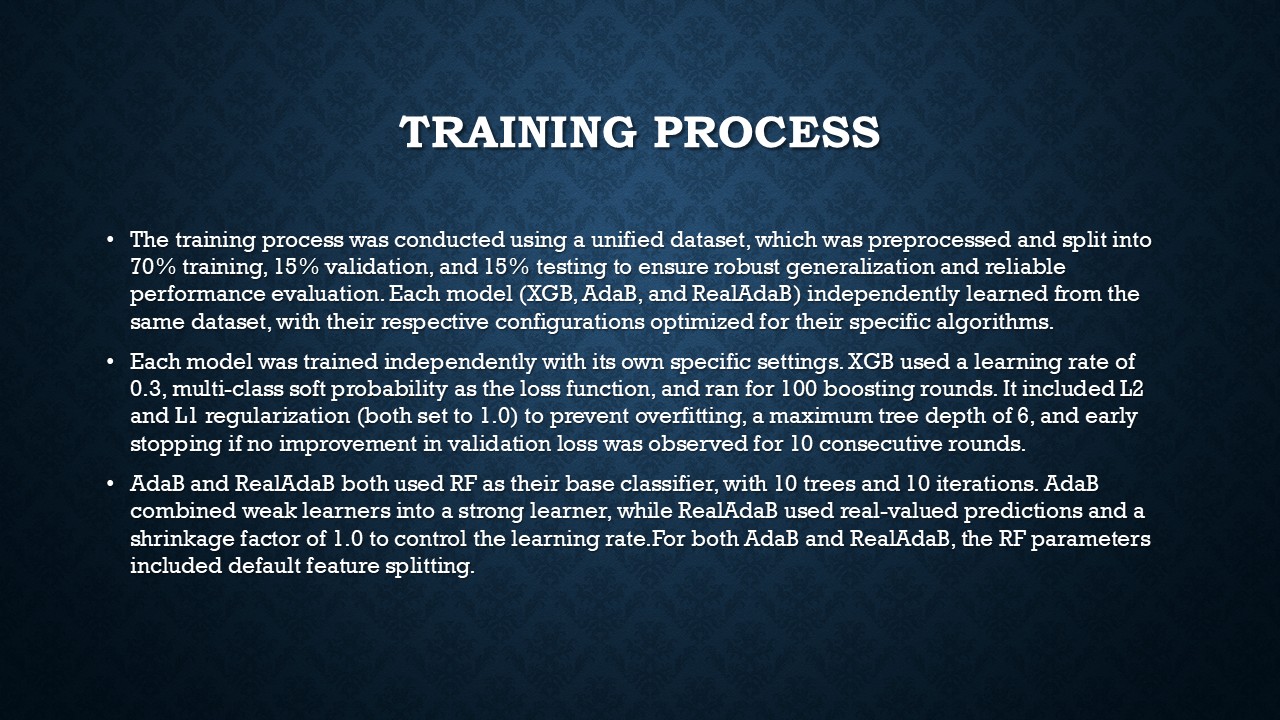
In the training phase, a unified phishing dataset was first preprocessed and then divided into three parts: 70% for training, 15% for validation, and 15% for testing. This split was used to ensure that the model can generalize well to unseen data while allowing reliable performance evaluation. Each classifier, including XGBoost, AdaBoost, and Real AdaBoost, was trained independently using the same dataset, but with configurations optimized for each specific algorithm.
For the XGBoost model, training was conducted using a learning rate of 0.3 and a multi-class soft probability loss function, with 100 boosting rounds. To reduce overfitting, both L1 and L2 regularization were applied, along with a maximum tree depth of 6. Early stopping was also implemented if no improvement was observed in validation loss for 10 consecutive rounds.
For AdaBoost and Real AdaBoost, Random Forest was used as the base classifier. Both models were trained using 10 trees and 10 boosting iterations. AdaBoost focuses on combining weak learners to form a strong learner, while Real AdaBoost uses real-valued predictions and applies a shrinkage factor to control the learning rate. Default feature splitting settings were used for the Random Forest base models to maintain training stability and consistency. |
 IEEE/ICACT20260061 Slide.13
[Big Slide]