 |
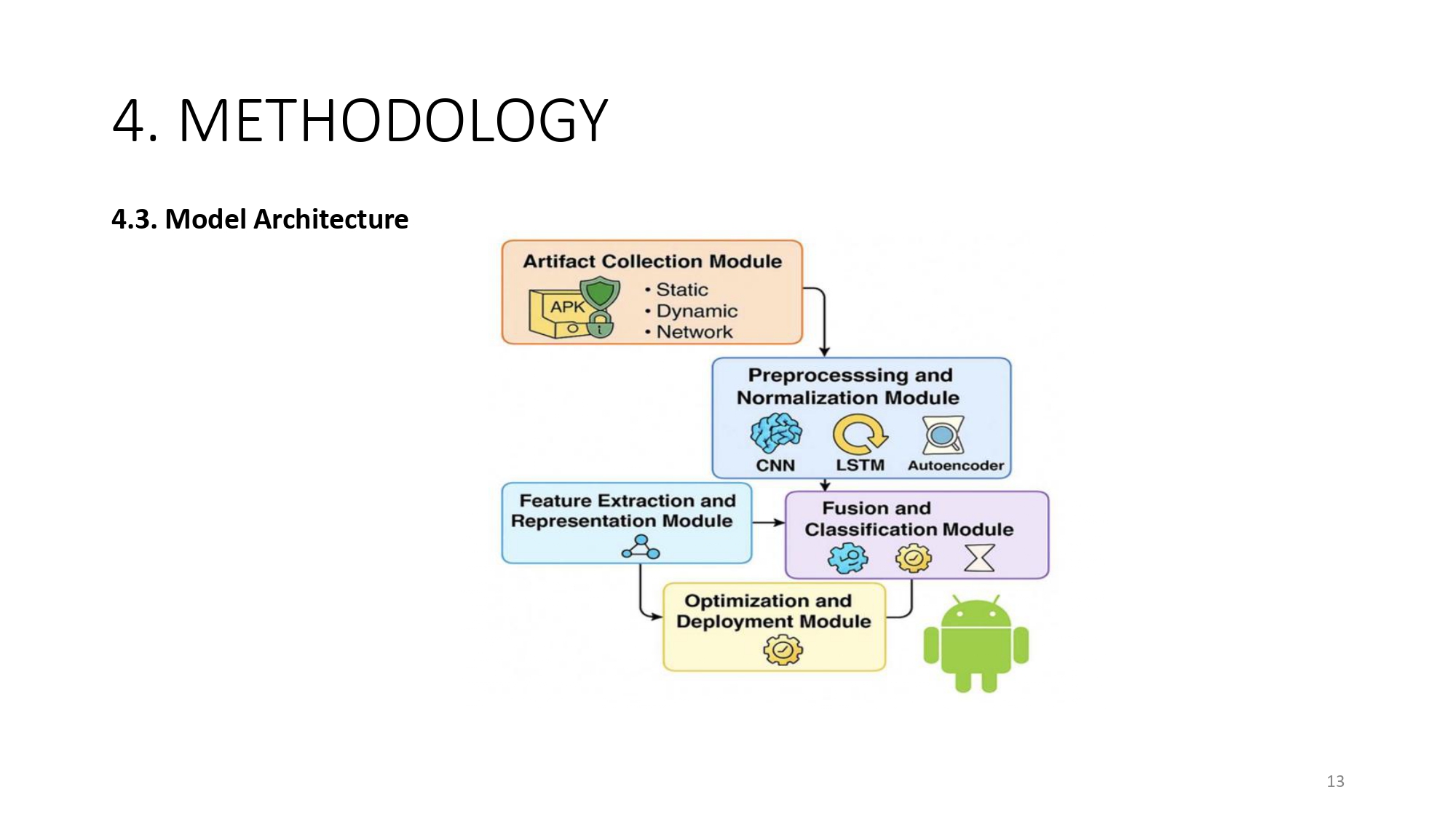
The proposed architecture is organized as a modular multimodal forensic pipeline. It begins with an artifact collection module that gathers static, dynamic, and network evidence from Android applications. These heterogeneous inputs are then processed by a preprocessing and normalization module, where CNNs handle static features, stacked LSTMs model temporal behavioral sequences, and autoencoders learn compact representations of network traffic. The extracted features are forwarded to a unified feature representation module and subsequently combined through a fusion and classification module, enabling joint decision-making across modalities. Finally, an optimization and deployment module applies model compression and tuning techniques to ensure efficient execution on Android devices. The entire architecture is trained using the Adam optimizer with dropout regularization and early stopping to improve generalization and prevent overfitting. |
 IEEE/ICACT20260079 Slide.13
[Big Slide]
[YouTube]