 |
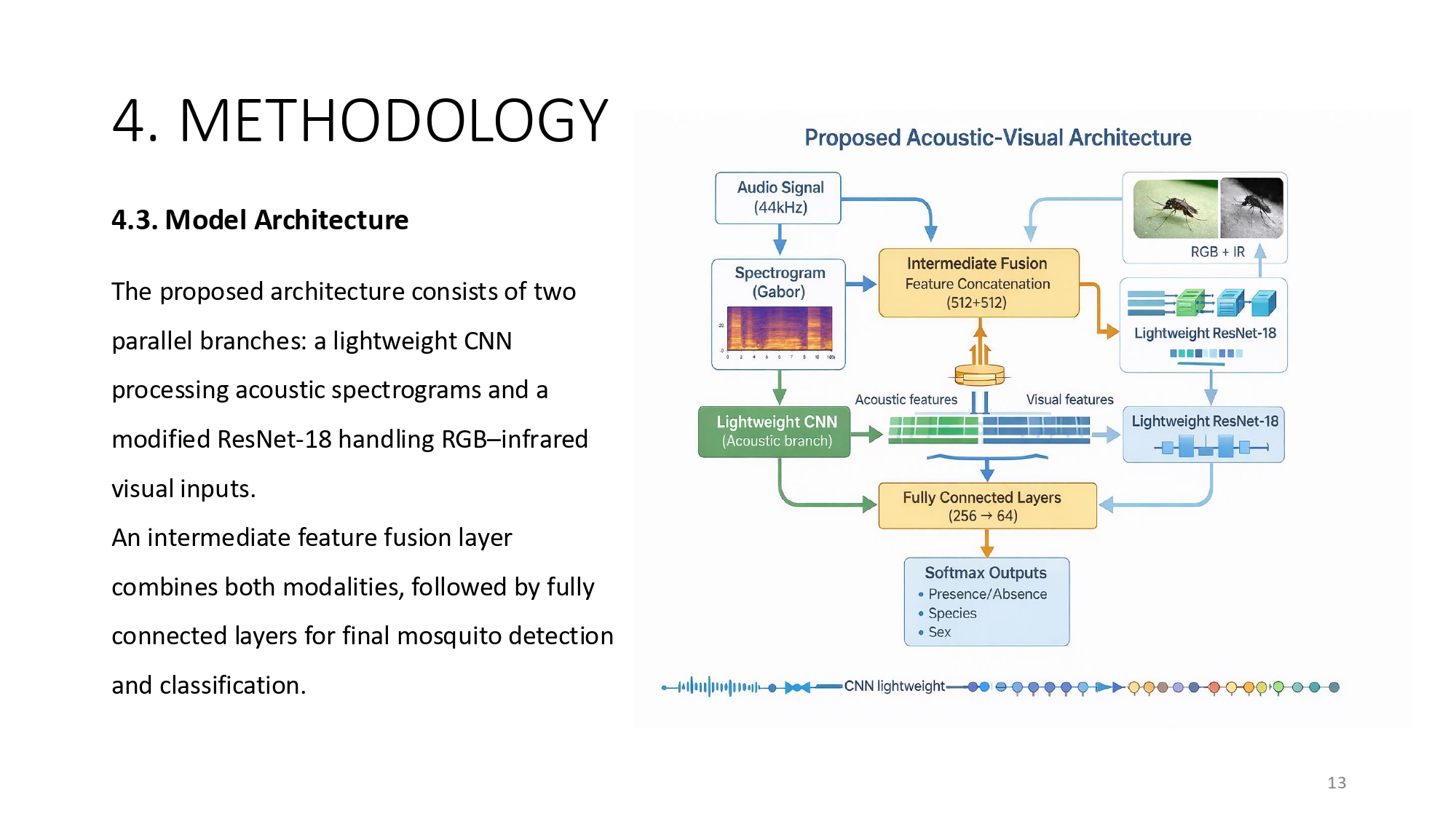
Our proposed architecture is composed of two parallel processing branches designed to handle acoustic and visual information independently. The acoustic branch relies on a lightweight CNN applied to Gabor spectrograms extracted from audio signals, while the visual branch is based on a modified and lightweight ResNet-18 that processes synchronized RGB and infrared frames. An intermediate feature fusion layer concatenates the learned representations from both modalities, enabling joint multimodal learning. The fused features are then passed through fully connected layers to perform final mosquito detection and classification tasks, including presence detection, species identification, and sex classification, while maintaining low computational complexity suitable for Edge AI deployment. |
 IEEE/ICACT20260085 Slide.13
[Big Slide]
[YouTube]