 |
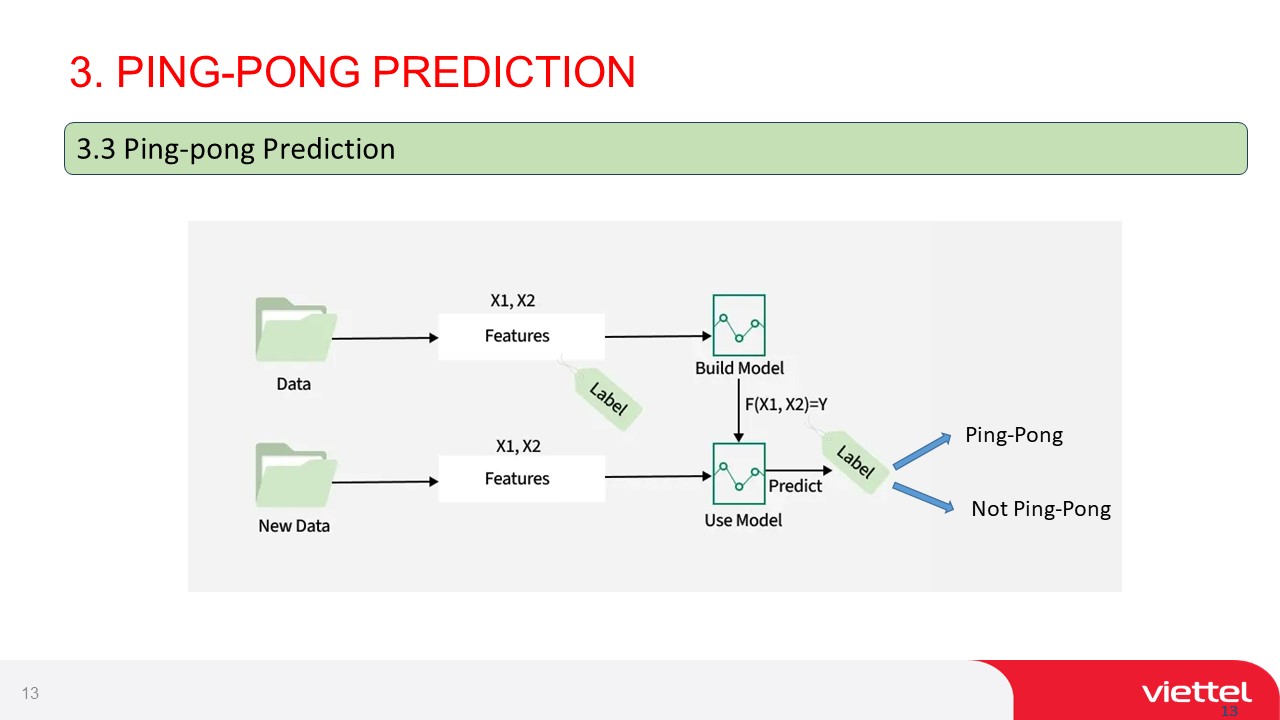
Slide 13 illustrates the end-to-end pipeline for our ping-pong prediction system. Lets walk through the key steps:
First, we have the data flow. Historical data is used to train the XGBoost model, while new incoming data is fed into the trained model for real-time prediction.
The feature engineering process is applied to both the historical and new data. This includes extracting the temporal, spatial, and contextual features we discussed earlier, such as handover intervals, cell identifiers, and cluster information.
Next, the XGBoost model is built using the historical data and corresponding ping-pong labels. The model learns the complex patterns and relationships between the input features and the likelihood of ping-pong events.
Finally, when a new handover request comes in, the trained model takes in the engineered features and outputs a prediction: either ping-pong or not ping-pong. This real-time prediction can then be used by the NWDAF to proactively optimize the handover process and prevent unnecessary ping-pongs.
By integrating this ML-driven prediction pipeline into the 5G network architecture, we enable a more intelligent and adaptive approach to mobility management. The NWDAF becomes a key enabler for delivering seamless, high-performance connectivity in dense, dynamic environments.
|
 IEEE/ICACT20260091 Slide.13
[Big Slide]