 |
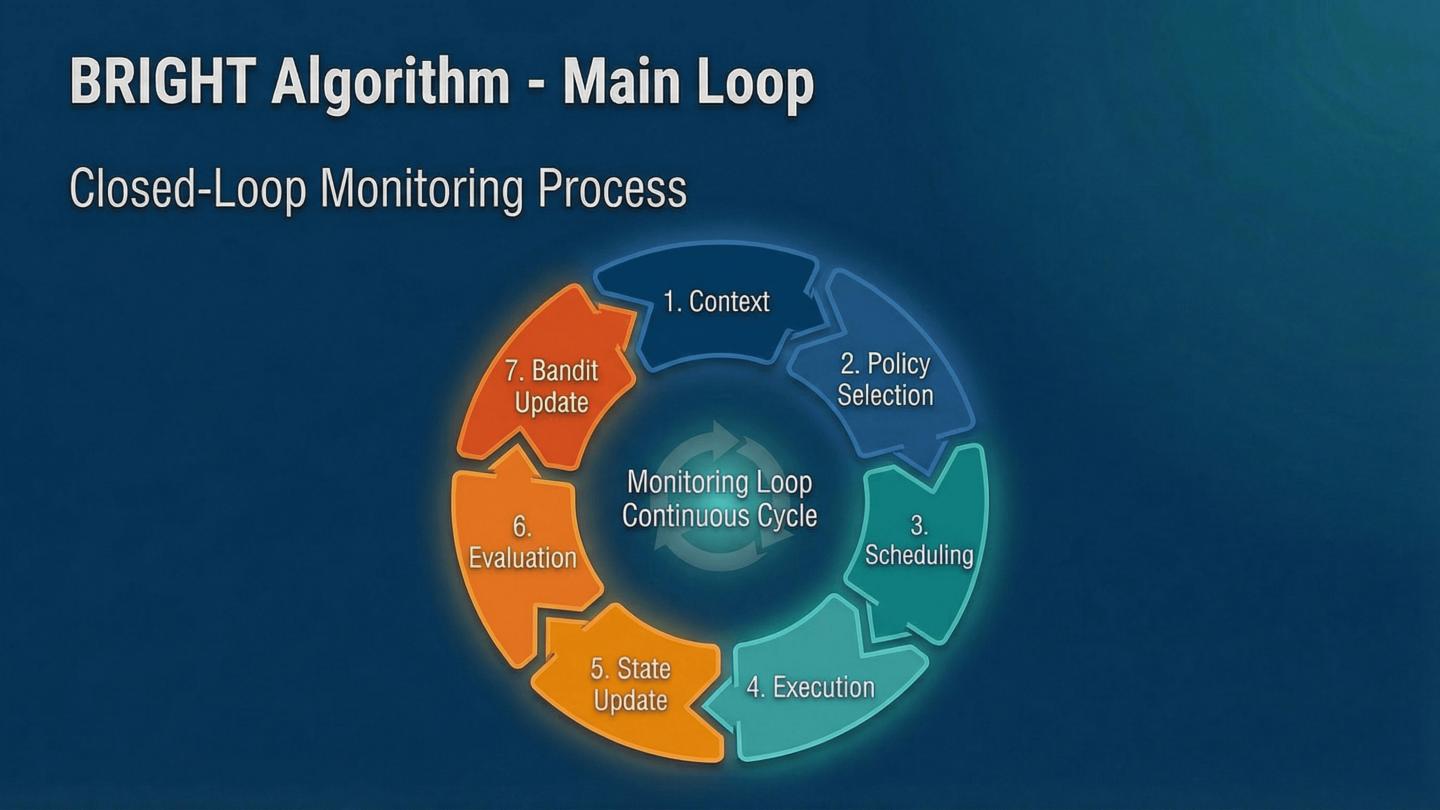
Weve now covered the three core components of BRIGHT: the Bayesian state estimation, the contextual bandit policy, and the spatio-temporal scheduler. This slide shows how they all fit together in the main operational loop. The process is continuous and slot-based. At the start of every time slot, the system first updates the flow state and uncertainty using any new counter samples collected in the previous slot. This is where the Bayesian model refines its estimates. Next, the Policy Module takes the current network state—the context—and uses the learned contextual bandit policy to select the optimal monitoring template for the next slot. This template dictates the overall monitoring intensity. Once the template is selected, the Spatio-Temporal Scheduler kicks in. It first determines the probing period for every flow based on its stability and the templates base period. Then, it selects the lowest-cost switch for each flow that needs to be probed in this slot. Finally, the Probe Executor sends the OpenFlow statistics requests to the selected switches, and the loop repeats. This continuous cycle of observe, decide, and act is the essence of BRIGHT. It ensures that monitoring is always adaptive, driven by uncertainty, and optimized for cost. This entire intelligence layer is implemented on the SDN controller, so lets look at the system implementation details.
|
 IEEE/ICACT20260358 Slide.13
[Big Slide]
[YouTube]