 |
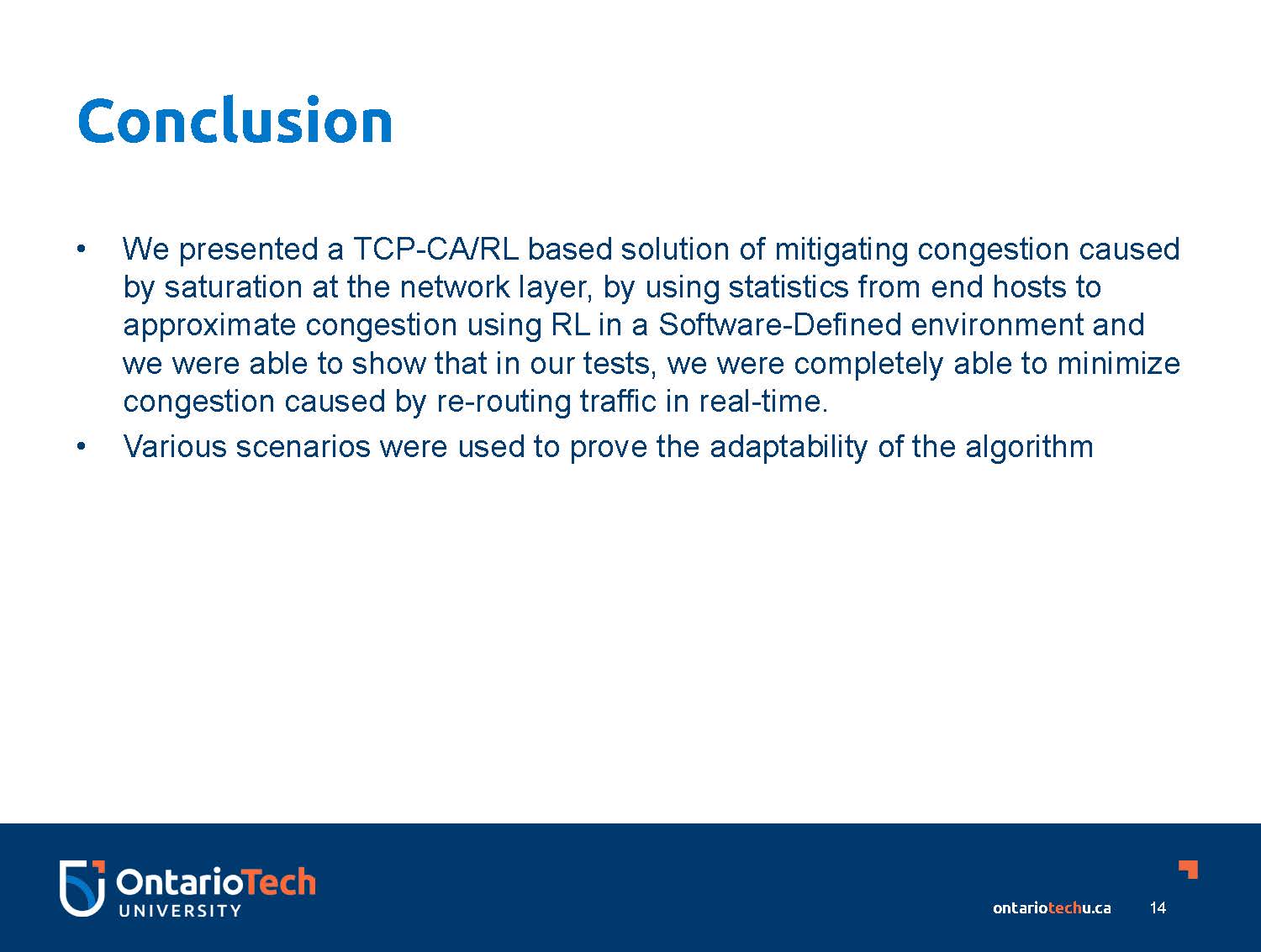
In this paper, we presented a TCP-CA/RL based solution
of mitigating congestion caused by saturation at the network
layer, by using statistics from end hosts to approximate congestion
using RL in a Software-Defined environment and we
were able to show that in our tests, we were completely able
to minimize congestion caused by re-routing traffic in realtime.
We also noticed the results were reproducible when run
multiple times, with some variation which was expected due to
the nature of our testing. Furthermore, we also confirmed that
the longer we have TCP-CA/RL learning about the topology
and if the knowledge carries over from iteration to iteration,
data transfer time is kept consistently low even in situations
where 3 out of the 4 uplinks are congested. The next steps
would be to test the algorithm in larger environments, with a
greater amount of data exchange to analyze the response of the
algorithm when run for a longer period of time. Theoretically,
the longer the algorithm is run, the better understanding it will
have of the environment so we should see an optimal transfer
time as if there was no congestion to begin with.
|
 IEEE/ICACT20210131 Slide.14
[Big Slide]