 |
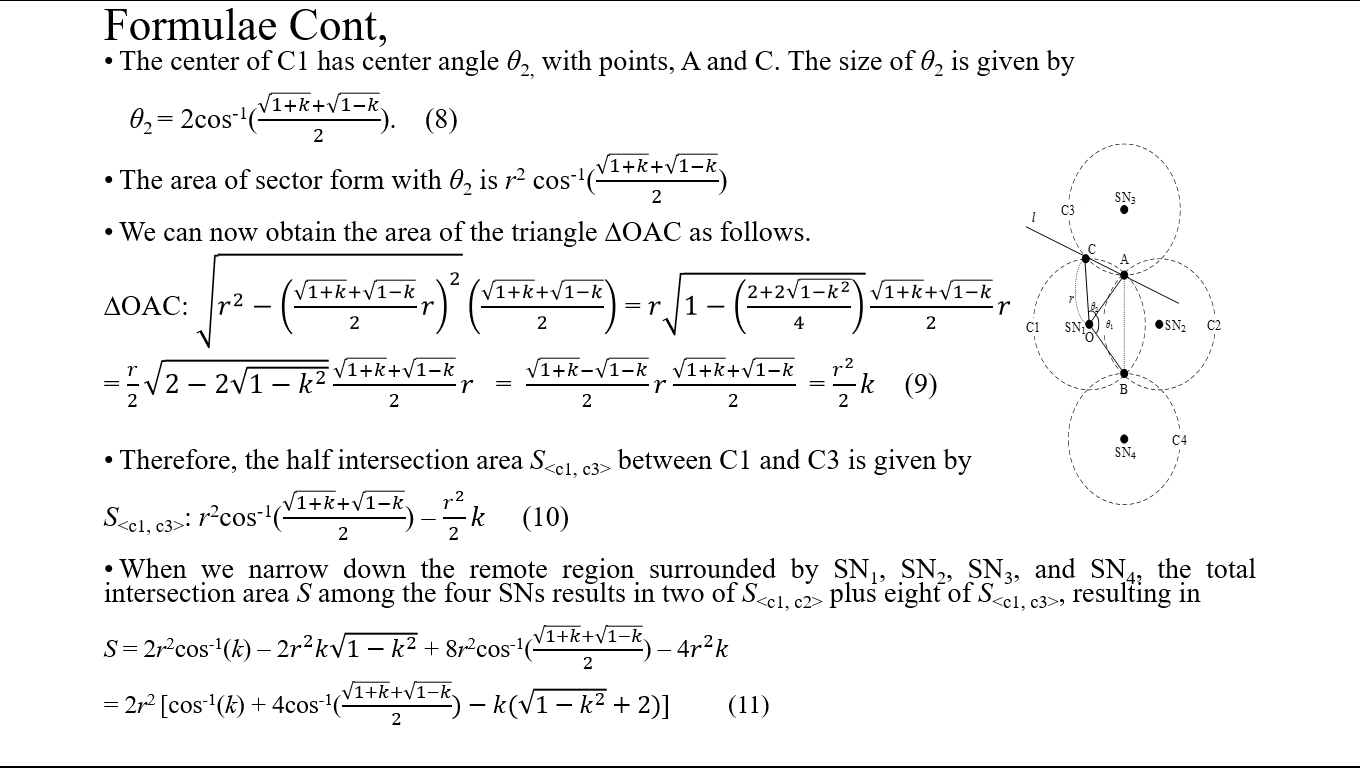
The center of C1 has center angle ¥è2, with points, A and C.
The size of ¥è2 is given by ¥è2 = 2cos-1((¡î(1+k)+¡î(1-k))/2)....(8)
The area of sector-form with ¥è2 is r2 cos-1((¡î(1+k)+¡î(1-k))/2)
We can now obtain the area of the triangle ∆OAC as follows:
∆OAC: ¡î(r^2-((¡î(1+k)+¡î(1-k))/2 r)^2 ) ((¡î(1+k)+¡î(1-k))/2) = r¡î(1-((2+2¡î(1-k^2 ))/4) ) (¡î(1+k)+¡î(1-k))/2 r =
r/2 ¡î(2-2¡î(1-k^2 (¡î(1+k)+¡î(1-k))/2 r = (¡î(1+k)-¡î(1-k))/2 r (¡î(1+k)+¡î(1-k))/2 = r^2/2 k ¡¦¡¦¡¦¡¦¡¦.. (9)
Therefore, the half intersection area S between C1 and C3 is given by S: r2cos-1((¡î(1+k)+¡î(1-k))/2) – r^2/2 k ¡¦¡¦¡¦. (10).
When we narrow down the remote region surrounded by SN1, SN2, SN3, and SN4, the total intersection area S among the four SNs results in two of S plus eight of S, resulting in S = 2r2cos-1(k) – 2r^2 k¡î(1-k^2 ) + 8r2cos-1((¡î(1+k)+¡î(1-k))/2) – 4r^2 k = 2r2 [cos-1(k) + 4cos-1((¡î(1+k)+¡î(1-k))/2)-k(¡î(1-k^2 )+2)] . .. . ....(11)
|
 IEEE/ICACT20210142 Slide.14
[Big Slide]