 |
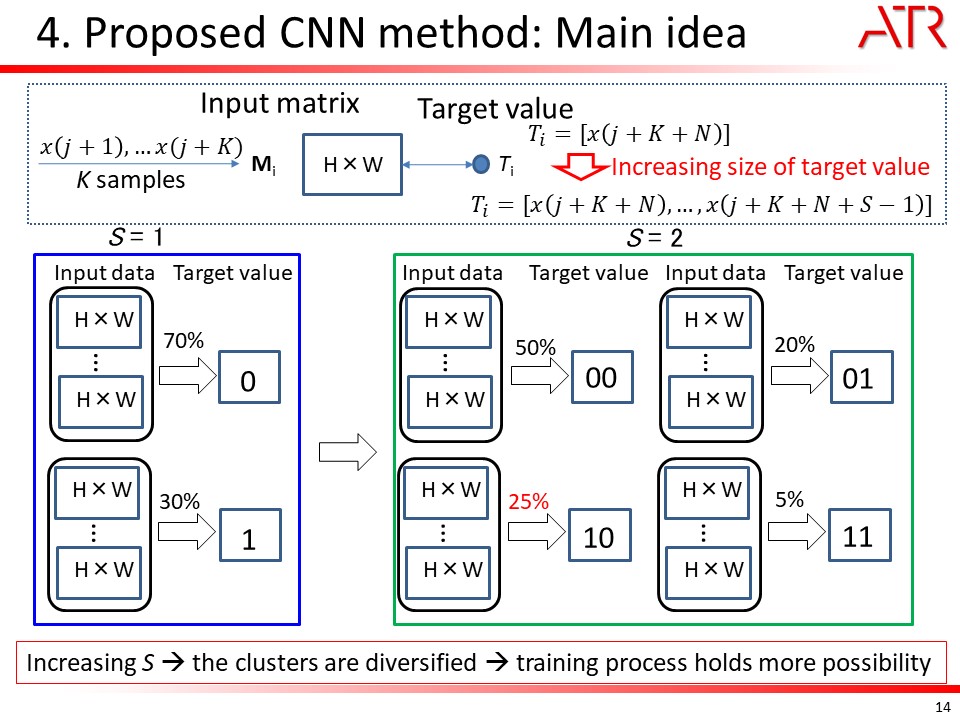
One efficient way to reduce such prediction loss is to make vectorization of target or increase the length of target. This figure shows the proposed idea. Suppose an on-off time-series data has two values as on (1) with 70% and off (0) with 30%, respectively. For the ith input matrix M_i of the conventional CNN, the target is usually a scalar (0 or 1) as T_i. Therefore, the training process finds the weight to make the predicted results as 1 or 0 with 70% or 30%, respectively. Therefore, even if some rare input matrices appear, the predicted values are also judged as 1 or 0 with 70% or 30%, respectively. Different with a single target, target vectorization can make the target value is not a scalar but a vector as. With this simple process, it can improve the prediction accuracy for the occurrence of some rare input matrices. From this figure, two consecutive data are used as one target for each input matrix. In such case, the target vector can be four candidates with different probabilities. This process makes the distribution more even than that of (S = 1). |
 IEEE/ICACT20210223 Slide.14
[Big Slide]