 |
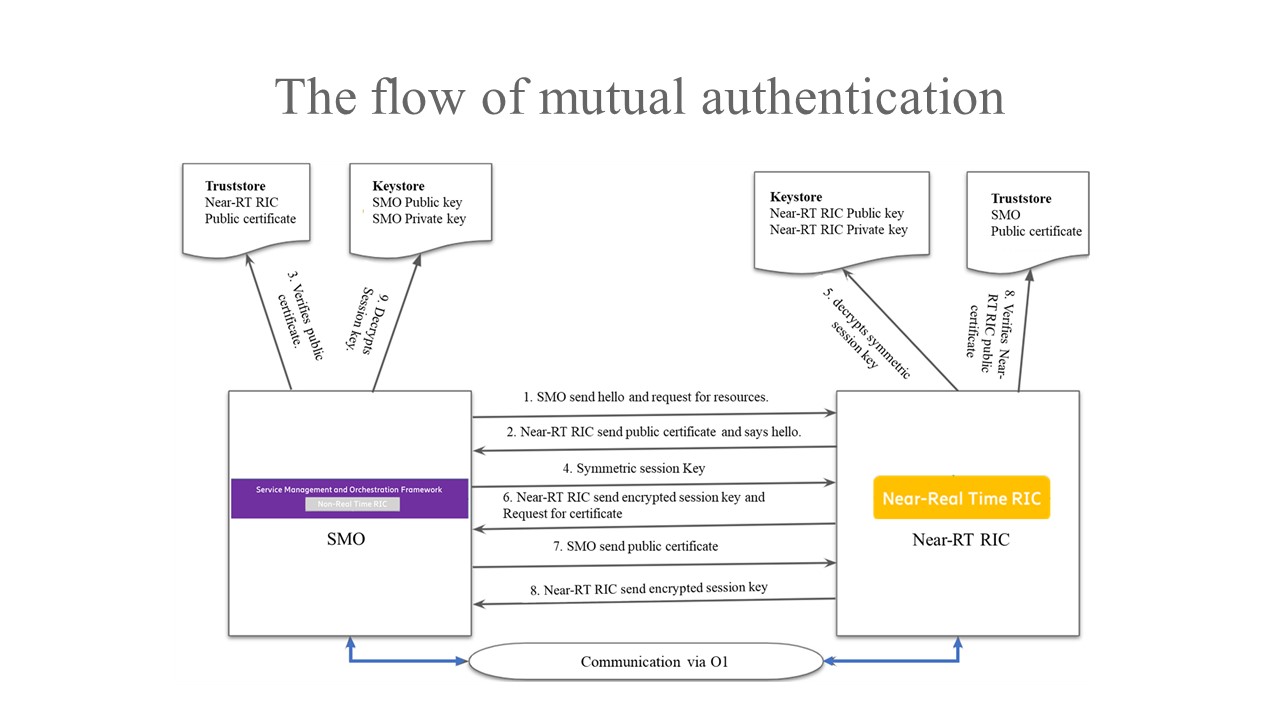
A detailed description of mutual authentication is shown in Figure 5. At the SMO, a keystore stores the private and public certificate of the SMO, whereas a truststore stores the public certificate of the Near-RT RIC. Meanwhile, at the Near-RT RIC, a keystore stores the private and public certificate of the Near-RT RIC, whereas a truststore stores the public key of the SMO. First, the SMO will send a ¡°Hello¡± message to Near-RT RIC and request for Near-RT RIC resources. When the Near-RT RIC receives the ¡°Hello¡± message, it will respond to the SMO with its public certificate (.crt) and return a ¡°Hello¡±. The SMO will verify the Near-RT RIC public certificate in its truststore. If the certificate is verified as valid and belongs to the Near-RT RIC, then SMO will generate a session key and use the public key of the Near-RT RIC to perform encryption. The Near-RT RIC will receive the session key sent by the SMO and then use its private key to decrypt the encrypted session key. Subsequently, Near-RT RIC will return the session key to the SMO and requests for a public key certificate from the SMO. The SMO sends its public key certificate to the Near-RT RIC for verification. If it is verified that the public key is valid and belongs to SMO, then the Near-RT RIC will use SMO¡¯s public key to encrypt the encrypted session key and return it to the SMO. When the SMO receives the encrypted session key sent by the Near-RT RIC, the SMO uses its private key to decrypt the encrypted session key, thereby completing the mutual authentication process.
|
 IEEE/ICACT20220039 Slide.14
[Big Slide]
[YouTube]