 |
We implemented the CHF with three major network models: bare metal, Calico and SR-IOV. Now, I will present the first 2 models and the SR-IOV model in the next slide.
In the bare metal model, all the components of vOCS run on the same operating system, sharing physical resources like CPU, RAM, and Network. This model does not suffer from the extra overhead caused by virtualization. However, heavy workload and frozen applications can impact the system as a whole, leading to degradation in quality of service.
Calico is a common Container Network Interface (CNI). So, what is CNI ? Kubernetes offers the option to integrate different network solutions through CNI plugins. A CNI plugin inserts a network interface into the container¡¯s network namespace. It also makes necessary changes to the network configuration on the host. The plugin also assigns an IP address to the interface and setup routes that are consistent with the IP Address Management section. It does so by invoking the appropriate IP Address management (IPAM) plugin.
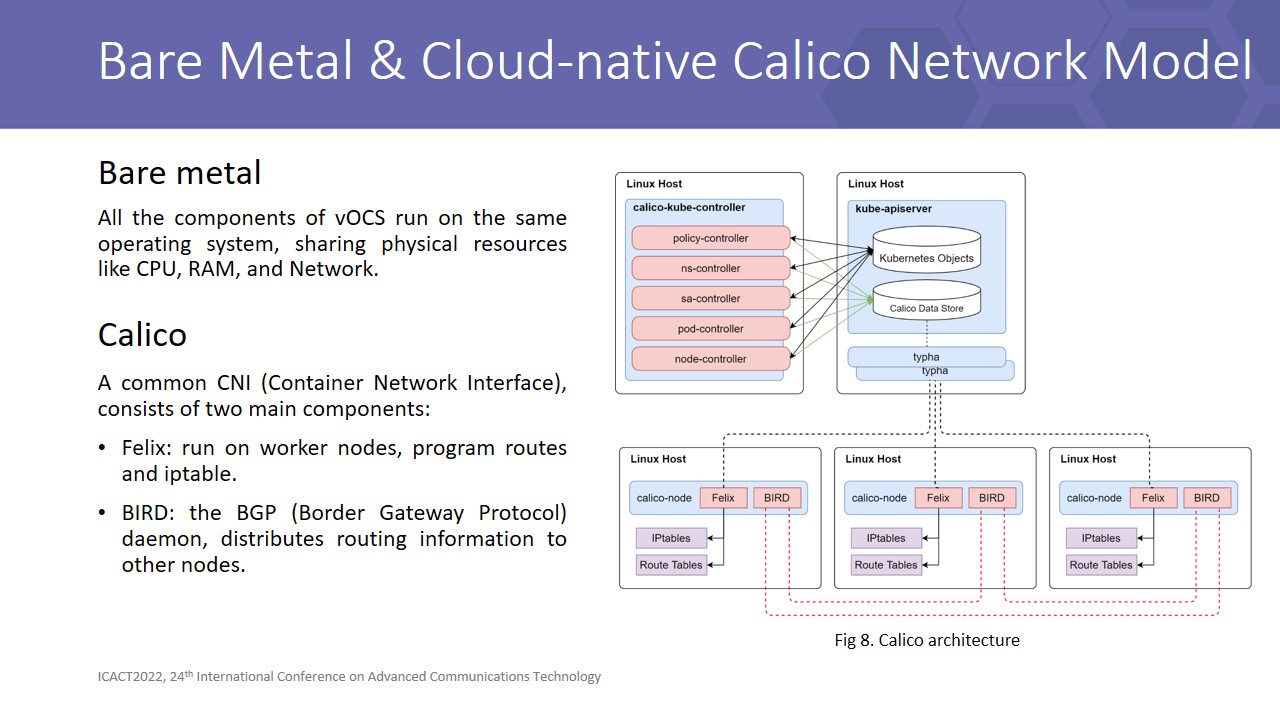
Calico creates overlay networks and establishes connections between pods across the nodes, but it also manages network security and administration. The Calico node agent consists of two main components: Felix and BIRD. Felix runs on machines that host endpoints and ensures that only valid traffic crosses endpoints, by programming routes and iptable on the host. BIRD is the BGP (Border Gateway Protocol) daemon that distributes routing information to other nodes. Calico supports three routing modes: Native, IP-in-IP, and VXLAN. The network model using Calico applies the IP-in-IP encapsulation type only to traffic crossing a subnet boundary. The rationale behind using Calico in our test bed was that it offers a satisfactory bandwidth while not prone to resource exhaustion.
|
 IEEE/ICACT20220041 Slide.14
[Big Slide]