 |
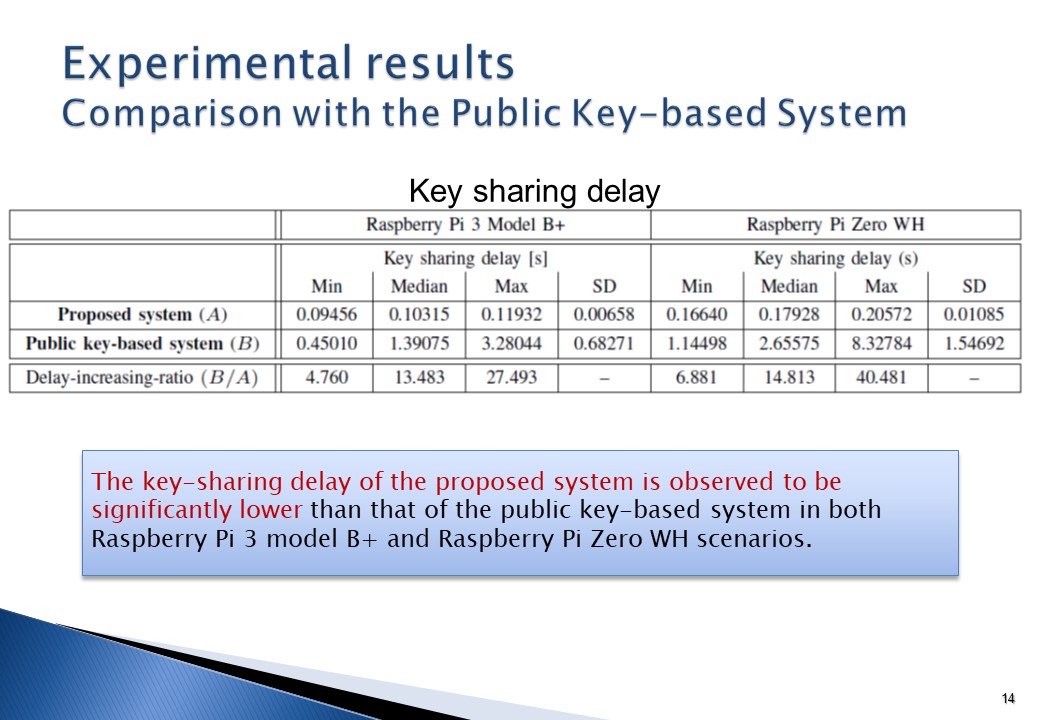
This slides shows the key-sharing delay performances of the proposed system and the public key-based system in the two scenarios.
The minimum, median, maximum, and standard deviation (SD) of the key sharing delay over a total of 30 measurements are tabulated in this table.
The delay-increasing-ratio (B/A) is calculated by dividing the key-sharing delay of the public key-based system (B) by that of the proposed system (A), which represents the delay performance ratio between the public key-based system and the proposed system.
The key-sharing delay of the proposed system is observed to be significantly lower than that of the public key-based system in both Raspberry Pi 3 model B+ and Raspberry Pi Zero WH scenarios.
The median of the key-sharing delay of the public key-based system is observed to be approximately 13.5–14.8 times higher than that of the proposed system.
The longer delay of the public key-based system is attributed to the heavy computational load of prime number generation.
The delay performance of the proposed system is verified to be stable with a small variation.
The standard deviations in the Raspberry Pi 3 model B+ and Raspberry Pi Zero WH scenarios are observed to be 0.00658 and 0.01085, respectively.
On the other hand, the variation of the delay performance of the public key-based system is significantly larger than that of the other.
The standard deviations in the Raspberry Pi 3 model B+ and Raspberry Pi Zero WH scenarios are 0.68271 and 1.54697, respectively.
In the scenario using the Raspberry Pi Zero WH board with lower CPU performance and smaller memory size, the variation of the key-sharing delay becomes much larger.
|
 IEEE/ICACT20220056 Slide.14
[Big Slide]