 |
Unfortunately, disinformation will always exist if it is very lucrative to generate and use. The survey also highlights some challenges in current research and opportunities that go with these challenges. The challenges around disinformation are including the following.
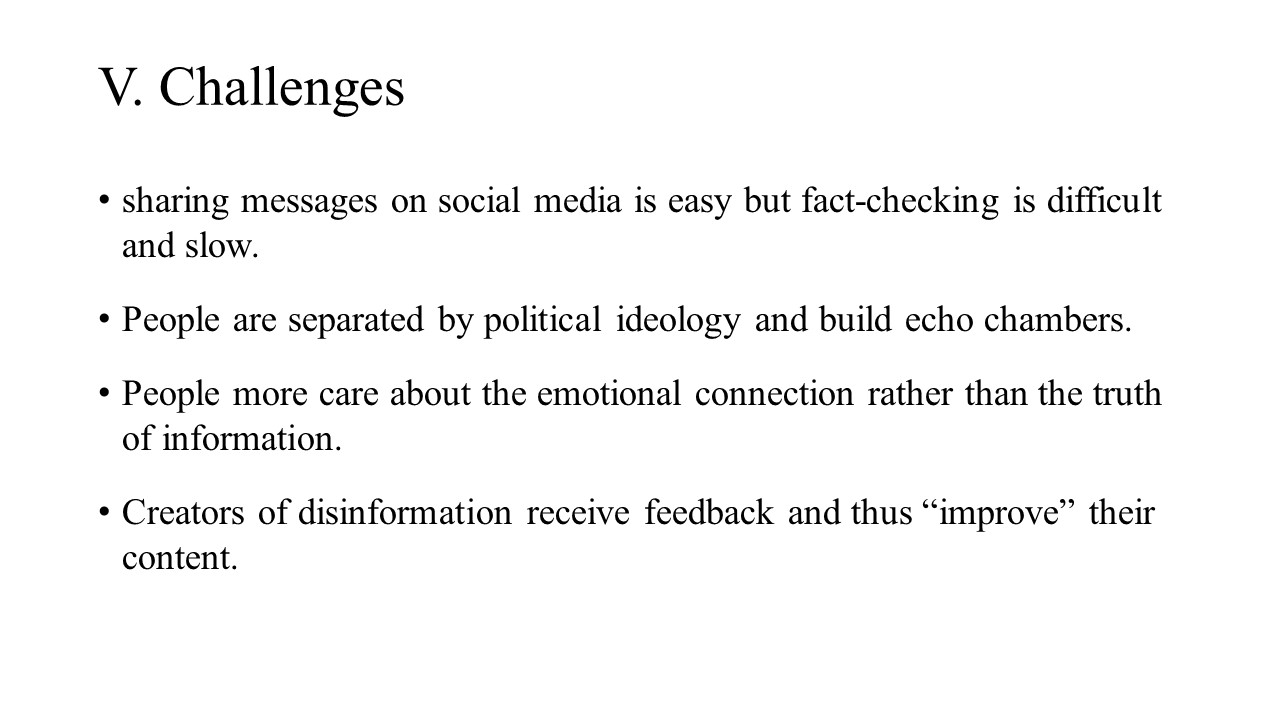
Social media are a hotbed for rapid propagation of disinformation because the sharing mechanism allows messages to be spread easily and fact-checking is difficult and slow.
People are separated by political ideology and build echo chambers. They then tend to seek out information that reinforces their beliefs without exposure to opposing opinions. Ultimately, people develop cognitive biases that can polarize nations.
People more care about the emotional connection on social media rather than the truth of information. Therefore, disinformation creators often stimulate readers¡¯ emotions - especially anger and fear - to motivate them to spread the disinformation further.
Creators of disinformation receive feedback from fact-checking mechanisms and thus ¡°improve¡± their content by mixing false and real information, adjusting their writing styles, and revising their semantics, making fact-checking increasingly difficult over time.
|
 IEEE/ICACT20220114 Slide.14
[Big Slide]
[YouTube]