 |
In the last scenario :
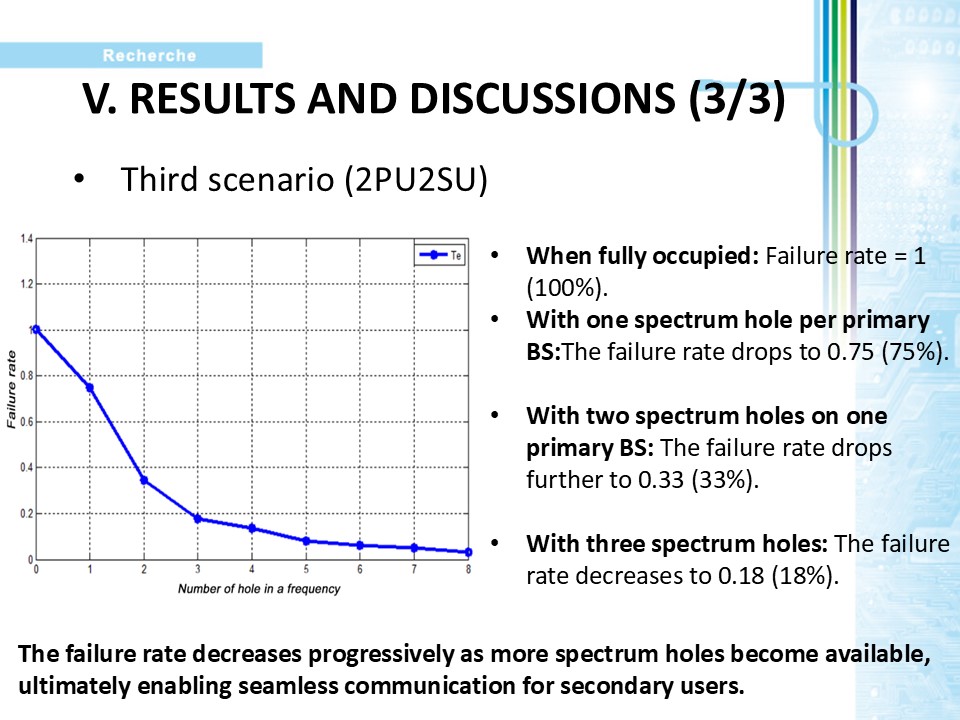
When the frequencies of both primary base stations are simultaneously busy, the failure rate is 1. This means that all channels are busy. This means that the two secondary SBs will not be able to transmit their SU's communications.
The rate drops from 1 to 0.75 when there is at least one available hole in each of the frequencies of the two primary SBs. The two SUs have at least one channel to communicate. This rate decreases to 0.33 when there are at least two holes available in either of the two primary SB frequencies.
In this way, the two secondary SBs each have at least two holes for transmitting their SU's communications. The rate decreases from 0.33 to 0.18 when at least three holes are available.
The rate decreases with the availability of holes in each frequency of the two primary SBs, until it reaches zero as the number of available holes increases.
|
 IEEE/ICACT20250130 Slide.14
[Big Slide]