 |
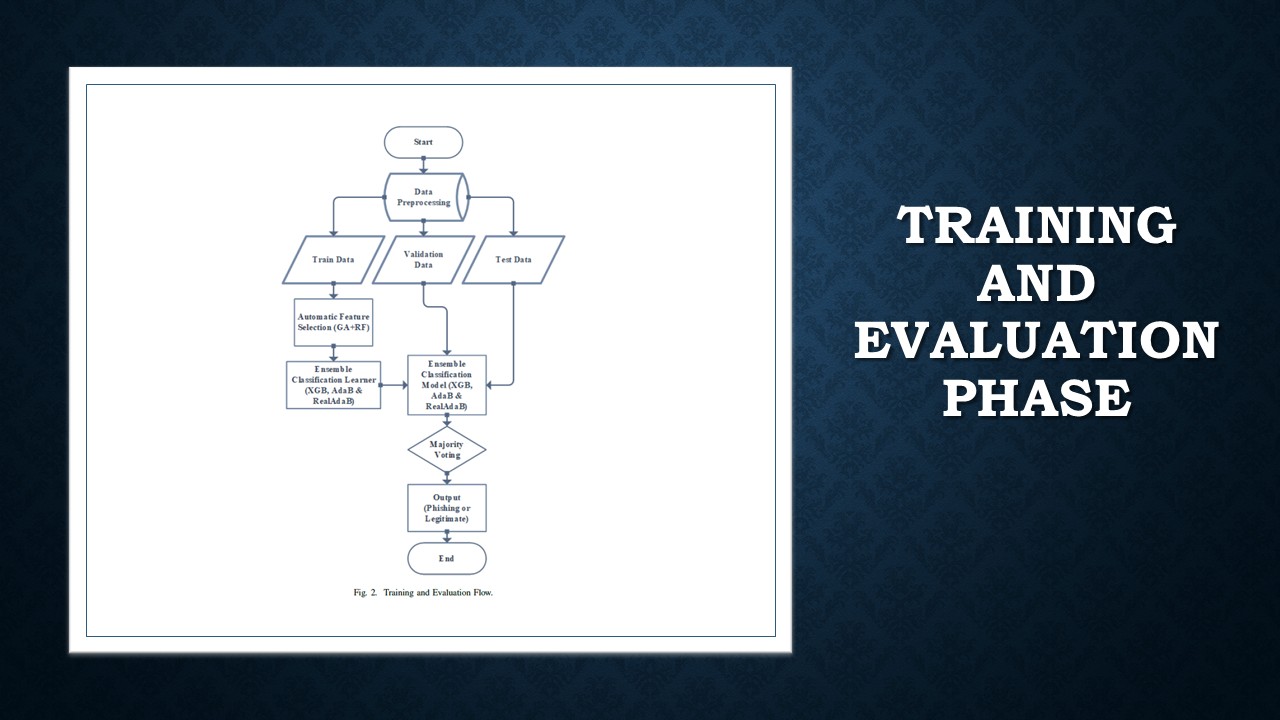
This diagram illustrates the overall training and evaluation workflow of the proposed phishing detection system. The process begins with data preprocessing, where the dataset is cleaned and prepared before being divided into training, validation, and testing datasets.
Next, the training data is passed through the automatic feature selection stage using the Genetic Algorithm combined with Random Forest to identify the most relevant features. These optimized features are then used to train the ensemble classification models, which include XGBoost, AdaBoost, and Real AdaBoost.
The validation dataset is used to fine-tune model parameters and prevent overfitting during training. Meanwhile, the testing dataset is used to evaluate the final performance of the trained models. The outputs from the ensemble classifiers are then combined using a majority voting mechanism to produce the final classification result, which determines whether a website is phishing or legitimate.
Overall, this structured training and evaluation pipeline ensures the model is well-optimized and effective in real-world phishing detection scenarios. |
 IEEE/ICACT20260061 Slide.14
[Big Slide]