 |
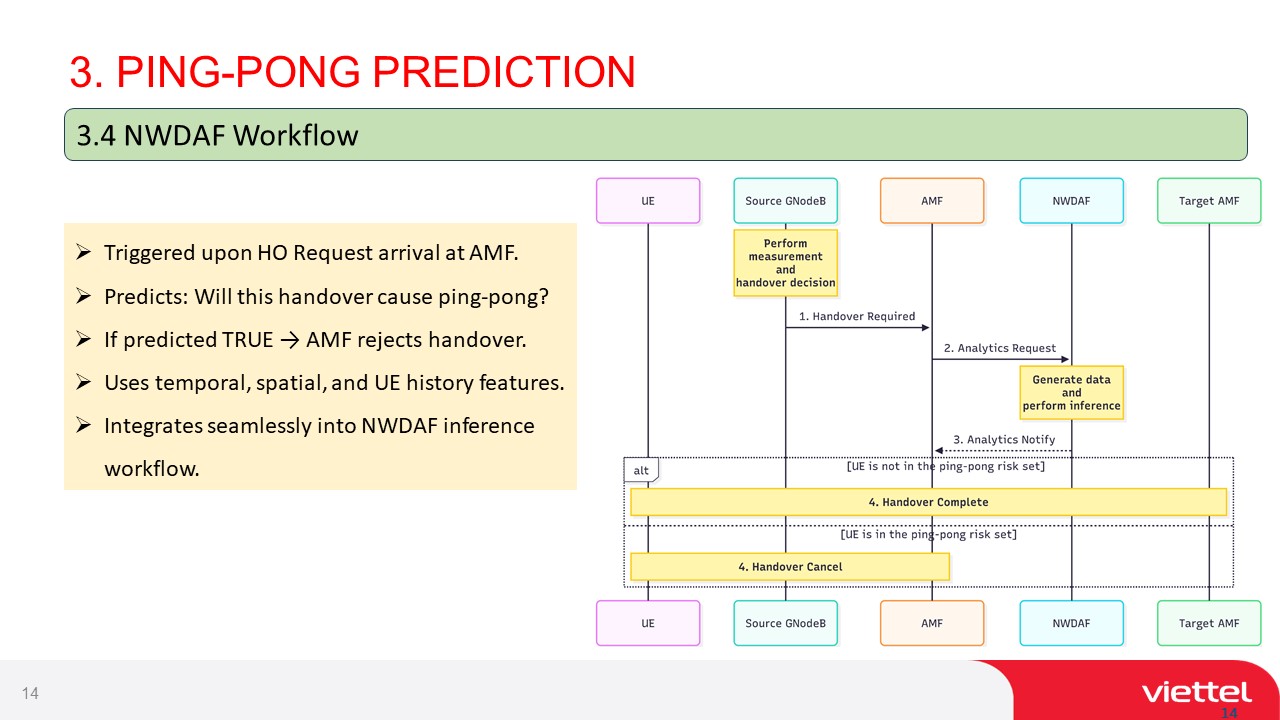
Slide 14 provides an overview of how our ping-pong prediction system integrates into the overall NWDAF workflow. Lets step through the process:
The workflow is triggered upon a handover request arrival at the AMF. The UE initiates the handover, which is then forwarded to the NWDAF for analysis.
The NWDAF performs measurement and handover decision tasks. It collects necessary data from the Source gNodeB and runs the prediction model.
Based on the models output, the NWDAF takes one of two actions:
If ping-pong is predicted, the NWDAF notifies the AMF, which then rejects the handover. This proactive rejection prevents unnecessary signaling and resource consumption.
If no ping-pong is predicted, the NWDAF allows the handover to proceed. It generates the relevant data and performs inference to optimize the handover process.
Once the handover is complete (or rejected), the NWDAF logs the outcome and updates its models for continuous learning and improvement.
This integrated workflow showcases the power of embedding ML intelligence into the 5G control plane. By leveraging the NWDAFs predictive insights, the network can make smarter, faster decisions about mobility management.
The end result is a more efficient, resilient, and adaptive network that proactively mitigates ping-pong effects and ensures seamless connectivity for end-users, even in challenging conditions. |
 IEEE/ICACT20260091 Slide.14
[Big Slide]