 |
Next is forwarding exhaustion.
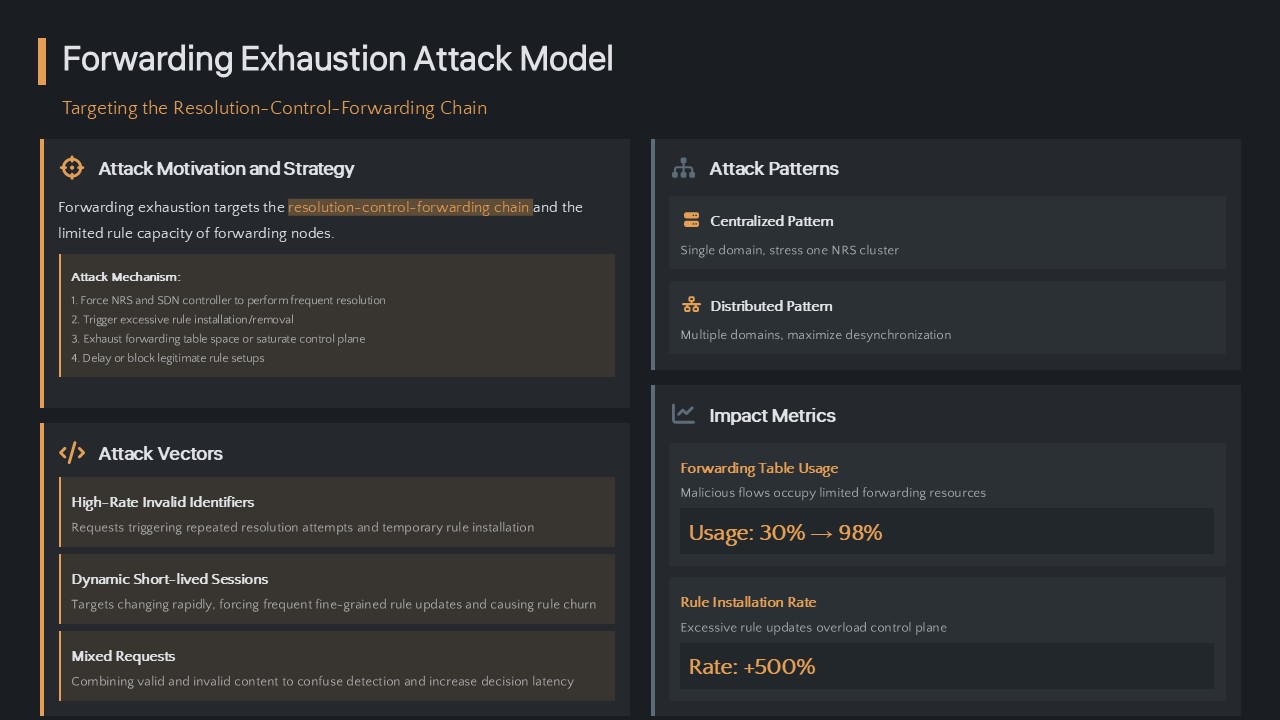
Here the attacker targets the resolution–control–forwarding chain and limited forwarding rule capacity. By forcing frequent resolution and rule installation or removal, the attacker can exhaust forwarding table space or saturate control-plane bandwidth, delaying legitimate rule setups.
Typical vectors include:
High-rate invalid-identifier requests, triggering repeated resolution attempts.
Dynamic short-lived sessions, where targets change rapidly, forcing frequent updates and rule churn.
Mixed requests, combining valid and invalid traffic to increase decision complexity and latency.
Attack patterns can be centralized in one domain or distributed across domains to maximize desynchronization and delay. |
 IEEE/ICACT20260343 Slide.14
[Big Slide]
[YouTube]