 |
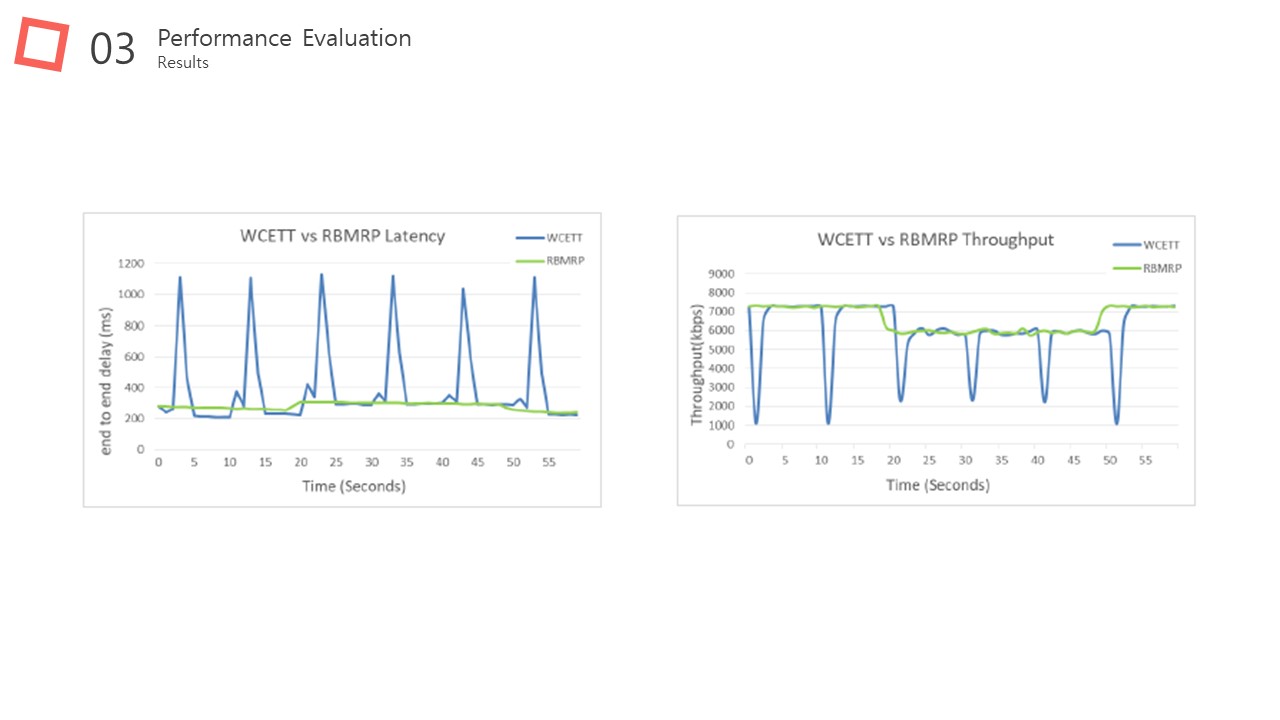
Left figure shows the simulation result for measuring the latency of the scenario by comparing WCETT and RBMRP.
WCETT periodically measures all link quality to the path and updates routing metrics of the path to detect and respond to changes in the network.
The way to measure the quality of a link is to exchange the probe message.
However, in the multi-radio multi-channel environment, the node should transmit the probe message to existing all channels to measure the quality of all links. Then, when the probe message is transmitted by channel, channel switching overhead occurs.
In our environment, 6 channel switching occurs at the time of one probe message exchange. For this reason, the latency of WCETT fluctuates periodically. By contrast, RBMRP also detects and responds to changes in the network by simply measuring RSSI. Measuring RSSI does not incur any extra cost. Therefore, RBMRP is superior to WCETT in terms of low latency.
Right figure shows the simulation result for measuring throughput by comparing WCETT and RBMRP.
This result indicates that the throughput of RBMRP is higher than WCETT because the throughput of WCETT is rapidly decreased when the probe message is exchanged.
But RBMRP doesnĄ¯t need a extra cost.
WCETT is famous for its efficient path with low latency and high throughput.
Then, RBMRP, which does not require a probe message, also shows better performance in the throughput part.
In terms of latency, however, it shows that RBMRP is more efficient than WCETT, which periodically generates probe messages.
That means, RBMRP does not require an extra cost for metric measurements, but it can discover a path that has similar performance to WCETT with an overhead for metric measurements.
|
 IEEE/ICACT20210196 Slide.15
[Big Slide]
[YouTube]
IEEE/ICACT20210196 Slide.15
[Big Slide]
[YouTube]