 |
Our network simulator is developed in Python
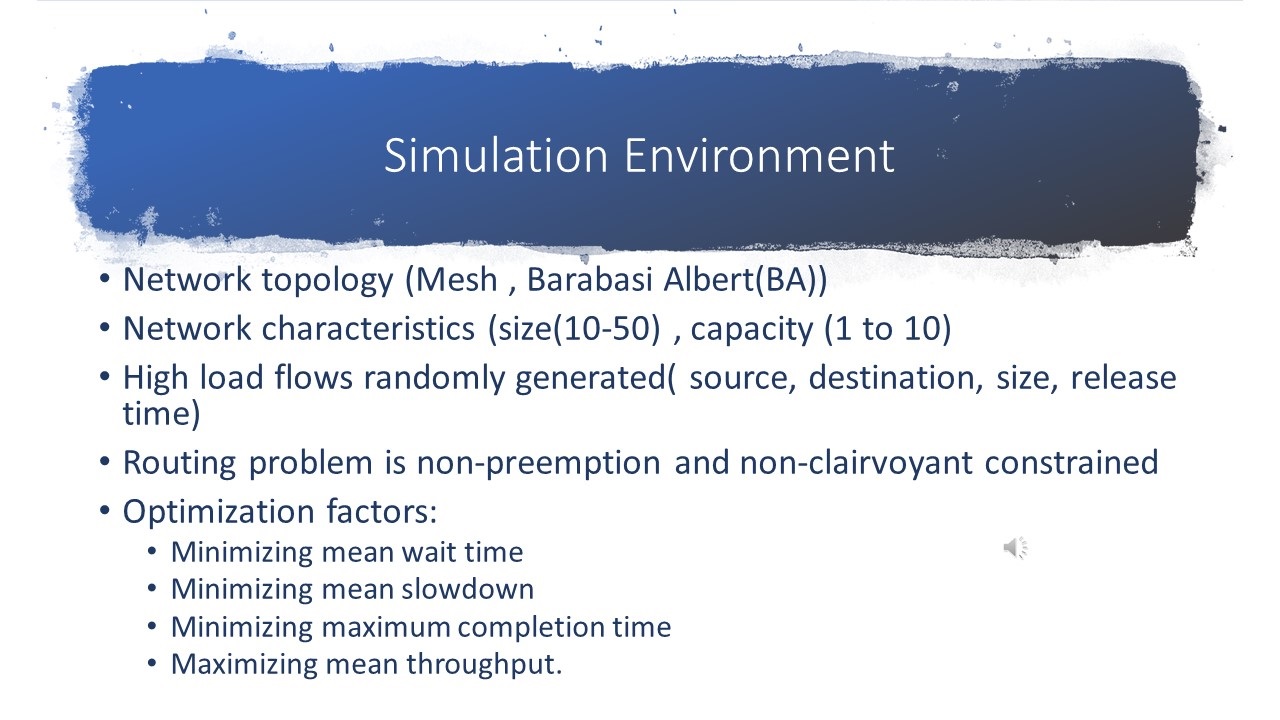
and it models an un-directed graph using two network topology: Mesh network and Barabasi Albert network.
Our mesh network is a partial mesh because it gave us a distinctive difference in our objective functions compared to the full connected mesh. And the Barabasi Albert network (AB), which adopts the concept of generating networks based on power law degree distribution, is generated using Networkx library.
The size of the network ranges from 10 to 50 nodes. For each generated network we randomly set each edge capacity between 1 and 10.
In general, a set of flows are randomly generated and simulate an online flows where clairvoyant is not enabled and we non-preemptively route them over the network graph
Each flow is described with source node, destination node, release time either identical or arbitrary, and flow size in either Gaussian or Pareto distribution.
The simulation calculates as network optimization factors: the mean wait time which is the average delay rate, the mean slowdown, the maximum completion time, and the mean throughput.
|
 IEEE/ICACT20210213 Slide.15
[Big Slide]
[YouTube]