 |
Conclusion:
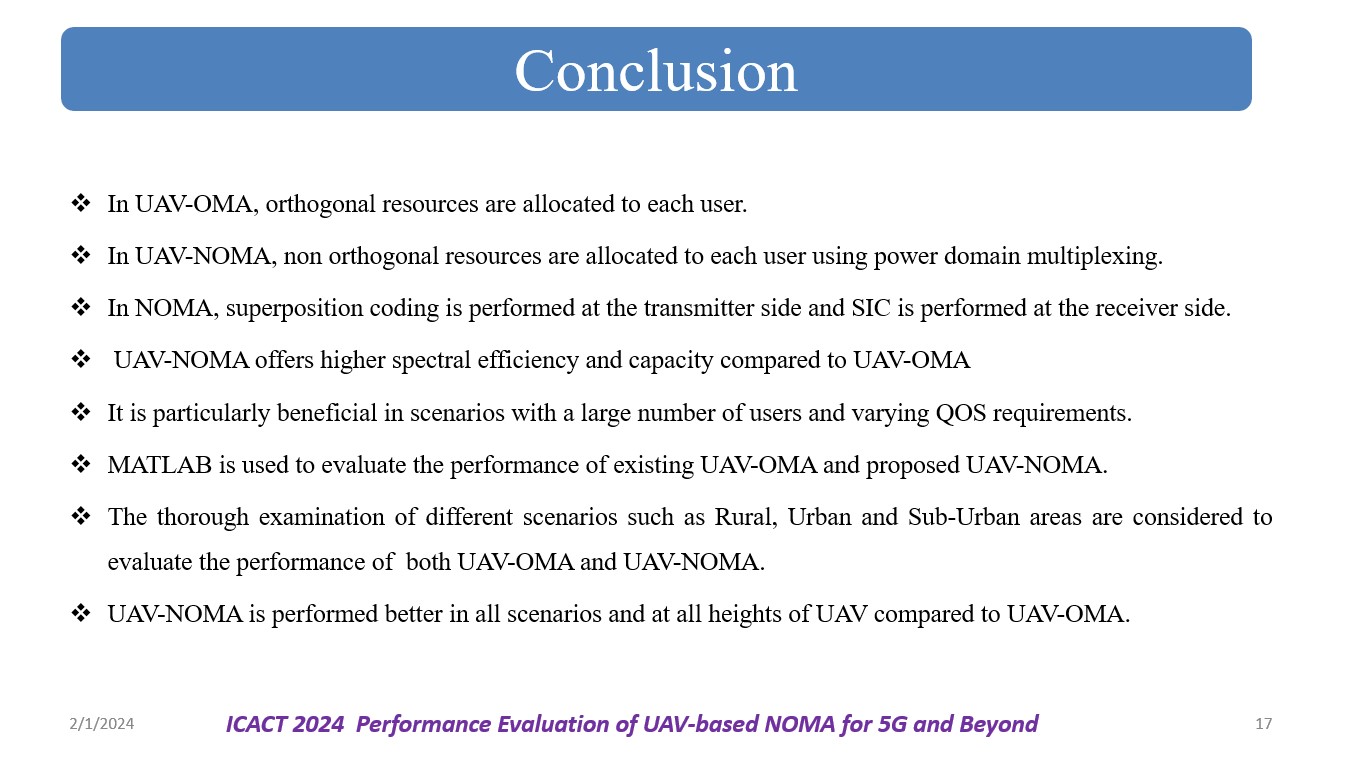
Finally, we can conclude that, in UAV-OMA, orthogonal resources are allocated to each user. And in UAV-NOMA, non-orthogonal resources are allocated to each user using power domain multiplexing.
In NOMA, superposition coding is performed at the transmitter side and SIC is performed at the receiver side.
Proposed UAV-NOMA offers higher spectral efficiency and capacity compared to existing UAV-OMA
It is particularly beneficial in scenarios with a large number of users and varying QOS requirements.
MATLAB is used to evaluate the performance of existing UAV-OMA and proposed UAV-NOMA.
The thorough examination of different scenarios such as Rural, Urban and Sub-Urban areas are considered to evaluate the performance of both existing UAV-OMA and proposed UAV-NOMA.
Proposed UAV-NOMA performs better in all scenarios and at all heights of UAV compared to existing UAV-OMA.
|
 IEEE/ICACT20240040 Slide.15
[Big Slide]