 |
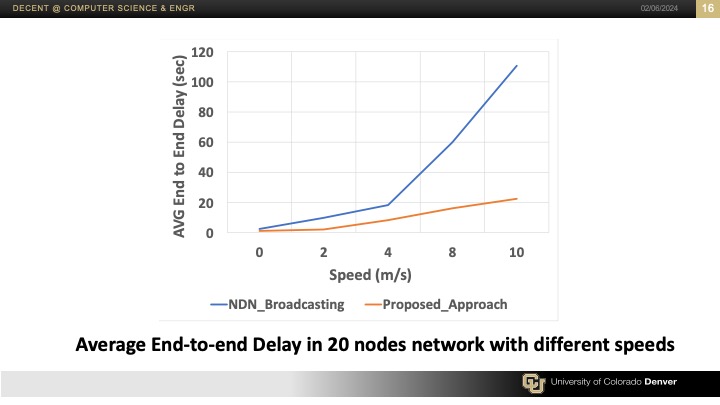
The next three slides shows the result of experiments for our proposed system and NDN broadcasting in a 20 nodes network. At lower
speeds (stationary to 4m/s), our approach performs better than NDN broadcasting across all metrics. However, it is not by a more significant margin, especially for the end-to-end delay and response time. The result of the packet delivery rate, however, clearly shows the disadvantage of the broadcasting approach. For the scenarios in which the nodes are either stationary or moving at lower speed, if the nodes are close together, broadcasting/flooding interest packets can lead to high frequency of packet collision in the network which in turn will result in lower delivery rate. When the nodes start moving faster, if the nodes are moving away from each other, it can help with the delivery rate of the broadcasting strategy as there are more spaces between each node (which can lead to less packet collision). However, this will come at the cost of introducing more traffics to the network. When we change the mobile nodes¡¯ moving speed from 4m/s to 8m/s, NDN broadcasting suffers a sharp increase in both response time and end-to-end delay while the change of
speed has a much lesser effect on our approach¡¯s performance. The increase in response time and end-to-end delay in our approach is due to the slight overheads incurred by recalculating the neighbor information when neighboring nodes start moving away from their original positions. |
 IEEE/ICACT20240480 Slide.15
[Big Slide]
[YouTube]