 |
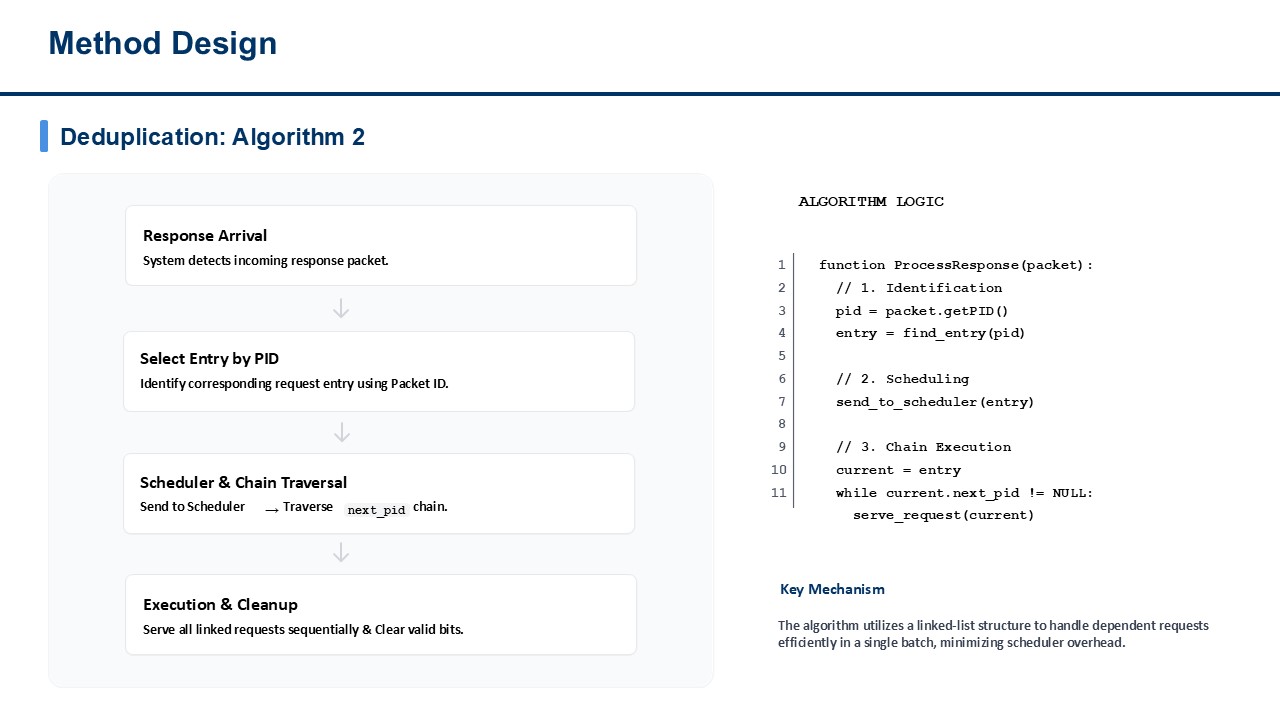
When the response finally returns from the host, the Outstanding Manager will process both PID 10 and PID 11 using the linked list, forwarding them back to the Scheduler Subsystem.
As shown in the flow diagram on the left, the process has four steps:
Step 1: Response Arrival. The system detects an incoming response packet from the host via the DMA engine.
Step 2: Select Entry by PID. Using the PID stored in the AXI ID field, the Outstanding Manager identifies the corresponding entry in the outstanding table.
Step 3: Scheduler . The system first sends the original request to the Scheduler Subsystem. Then, it traverses the next PID chain to find all linked duplicate requests.
Step 4: Cleanup. All linked requests are served sequentially, and the valid bits are cleared to free the table entries.
The key mechanism here is the linked-list structure. It allows us to handle all dependent requests efficiently in a single batch and ensuring all duplicate requests are served in order from just one host response. |
 IEEE/ICACT20260320 Slide.15
[Big Slide]
[YouTube]