 |
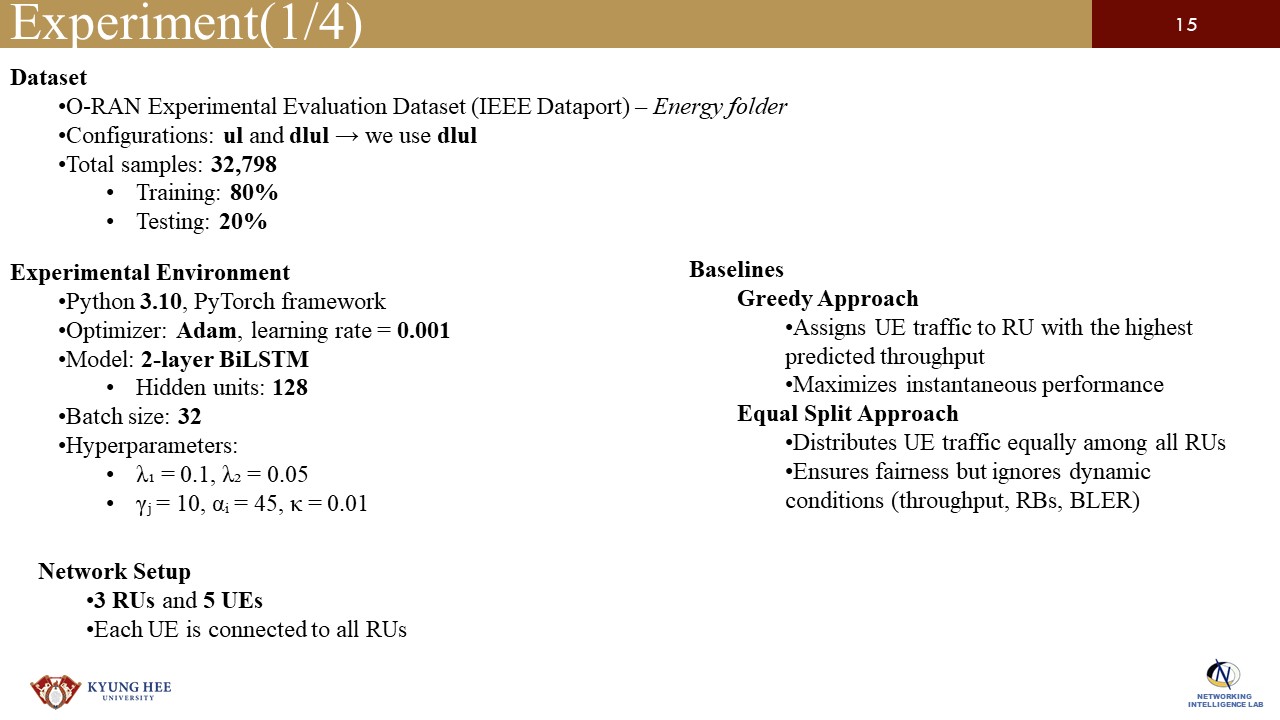
For our experiments, we use the O-RAN ˇ°dataset dlulˇ± from IEEE Dataport, containing 32,798 traffic samples split 80/20 for training and testing. The model is implemented in Python with PyTorch, using a 2-layer BiLSTM with 128 hidden units, trained with the Adam optimizer (learning rate 0.001) and batch size 32. Three RUs and five UEs are considered, with every UE connected to all RUs. We compare our BiLSTM-based prediction and optimization approach against baseline traffic steering methods—Greedy, which directs all traffic to the RU with highest predicted throughput, and Equal Split, which distributes traffic evenly. The BiLSTM model is also evaluated against FFN, CNN, LSTM, GRU, and Transformer models for next-slot prediction of throughput, BLER, and RB usage. Results show the BiLSTM achieves the lowest training MSE (0.0001), test MSE (0.10), and test MAE (0.05), closely matching ground truth values and outperforming all baselines in accuracy while maintaining reasonable model complexity.
|
 IEEE/ICACT20260367 Slide.15
[Big Slide]