 |
Now I’d like to sum up my presentation with following points.
Using digital twins that replicate the physical city to create a virtual city, we can simulate urban planning before implementation.
In this paper, we created a virtual city model that can simulate the movement of people and predict urban change and population movement.
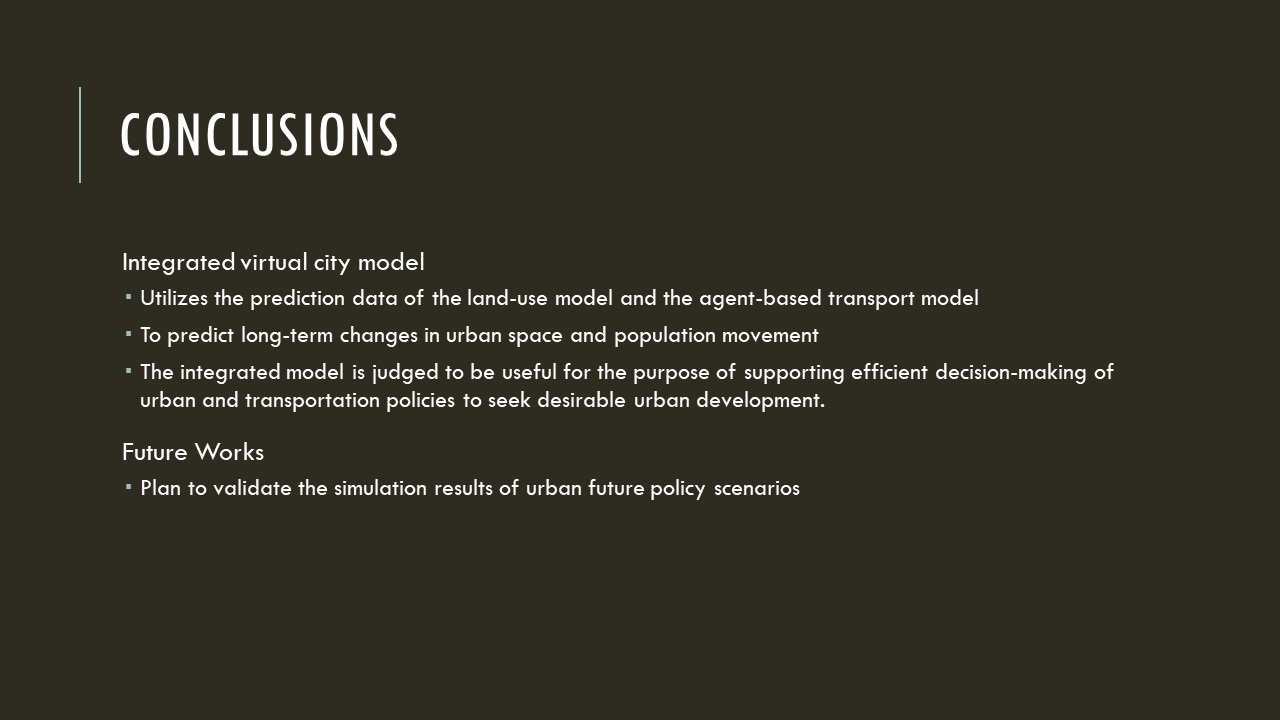
In particular, we proposed an integrated virtual city model that utilizes the prediction data of the land-use model and the agent-based transport model to predict long-term changes in urban space and population movement.
The integrated model is judged to be useful for the purpose of supporting efficient decision-making of urban and transportation policies to seek desirable urban development.
The integrated virtual city model can be exploited for the purpose of supporting efficient decision-making of urban and transport policies to seek desirable urban development.
As a future work, we plan to validate the simulation results of urban future policy scenarios.
|
 IEEE/ICACT20220398 Slide.16
[Big Slide]