 |
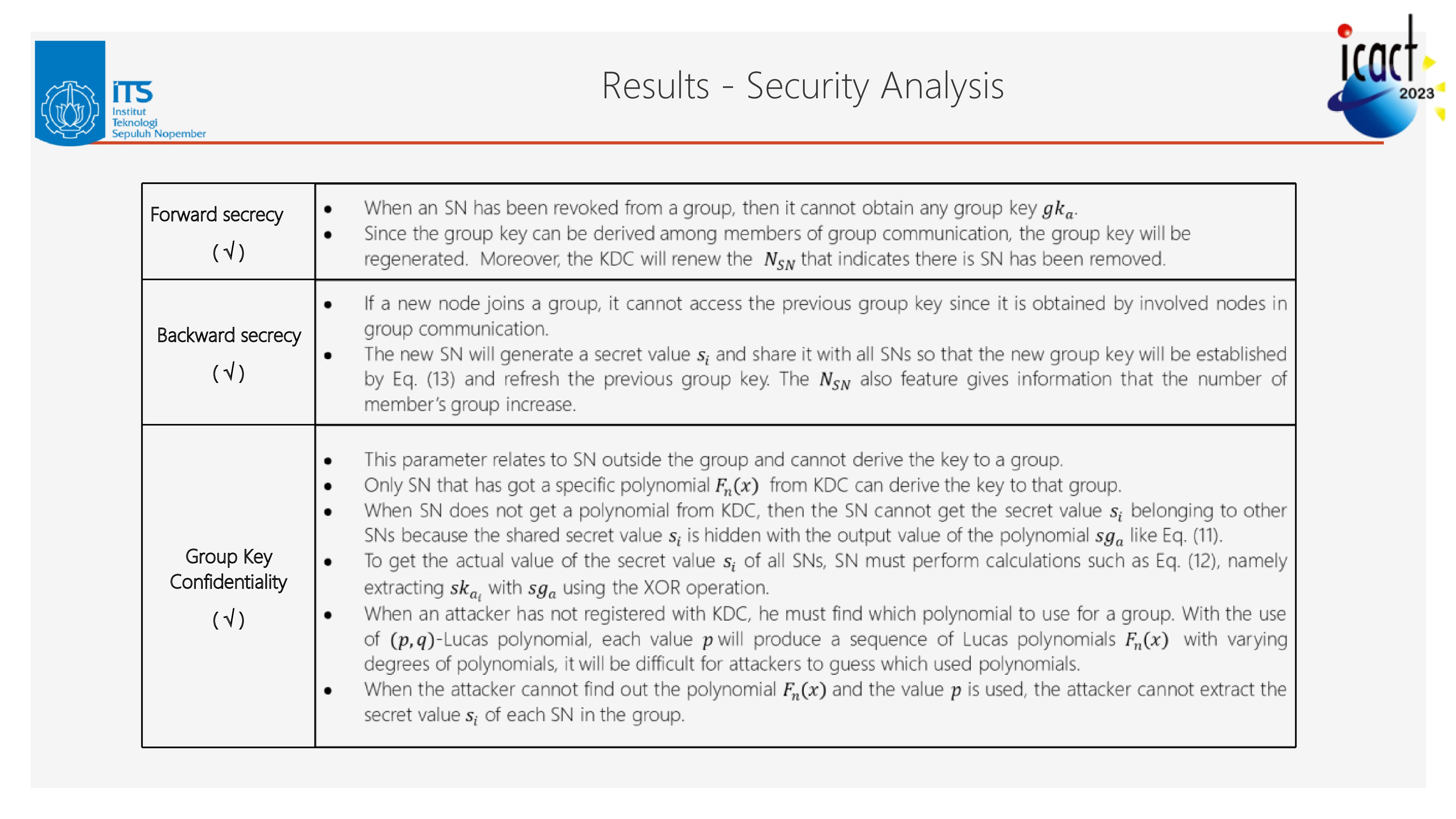
Forward secrecy:
-When an SN has been revoked from a group, then it cannot obtain any group key.
-Since the group key can be derived among members of group communication, the group key will be regenerated. Moreover, the KDC will renew the 𝑁_𝑆𝑁 that indicates there is SN has been removed.
Backward secrecy:
-If a new node joins a group, it cannot access the previous group key since it is obtained by involved nodes in group communication.
-The new SN will generate a secret value and share it with all SNs so that the new group key will be established by Eq. (13) and refresh the previous group key. The 𝑁_𝑆𝑁 also feature gives information that the number of member¡¯s group increase.
Group key confidentiality:
-This parameter relates to SN outside the group and cannot derive the key to a group.
-Only SN that has got a specific polynomial 𝐹_𝑛(𝑥) from KDC can derive the key to that group.
-When SN does not get a polynomial from KDC, then the SN cannot get the secret value belonging to other SNs because the shared secret value is hidden with the output value of the polynomial like Eq. (11).
-To get the actual value of the secret value of all SNs, SN must perform calculations such as Eq. (12).
-When an attacker has not registered with KDC, he must find which polynomial to use for a group. With the use of (𝑝,𝑞)-Lucas polynomial, each value 𝑝 will produce a sequence of Lucas polynomials 𝐹_𝑛(𝑥) with varying degrees of polynomials, it will be difficult for attackers to guess which used polynomials.
When the attacker cannot find out the polynomial 𝐹_𝑛(𝑥) and the value 𝑝 is used, the attacker cannot extract the secret value of each SN in the group.
|
 IEEE/ICACT20230044 Slide.16
[Big Slide]
[YouTube]