 |
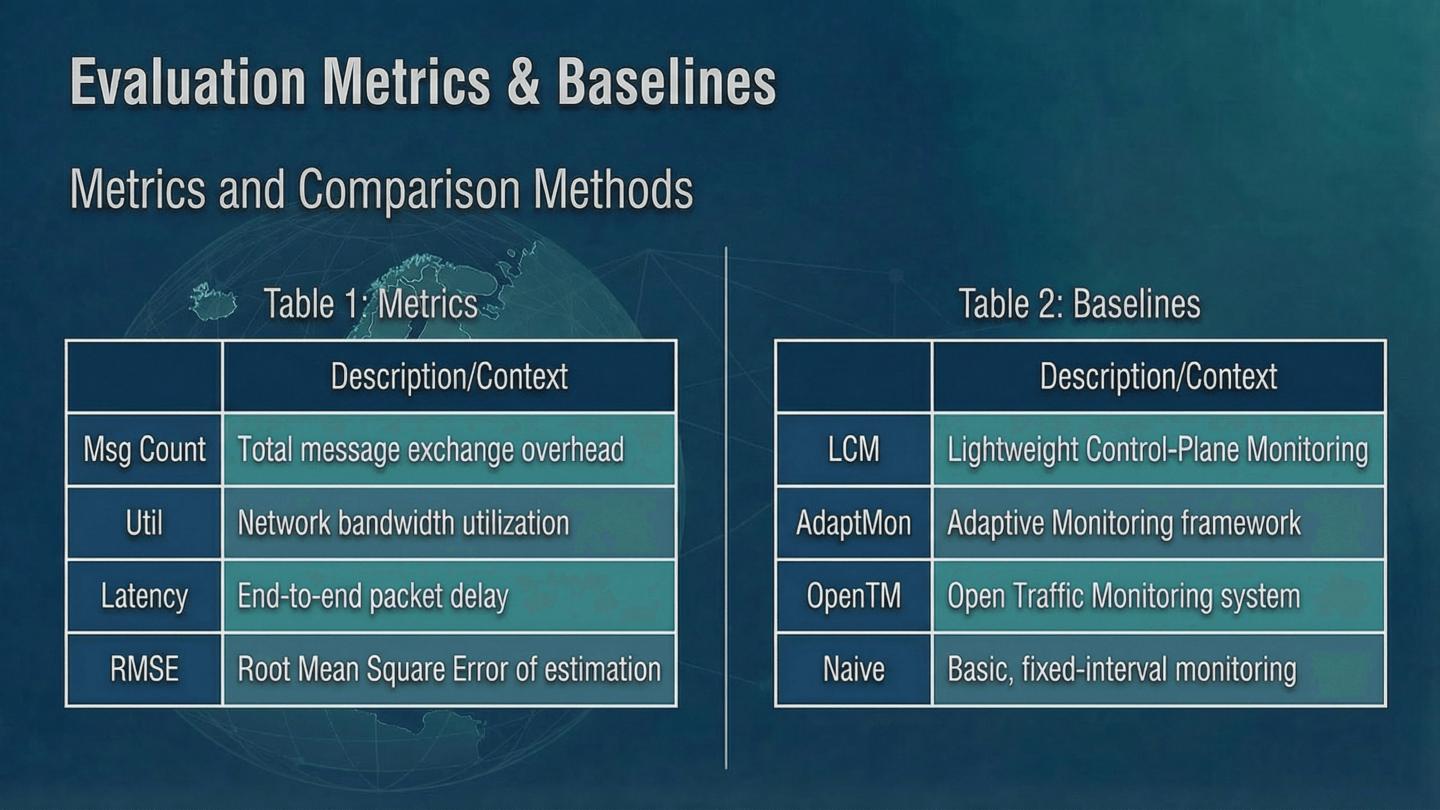
Lets look at the metrics we used to evaluate BRIGHT and the baselines we compared against. Our evaluation focuses on the critical trade-off between measurement accuracy and monitoring overhead. We used five primary metrics to capture this balance. First, we measured the total number of monitoring messages per slot, which directly quantifies the control-plane overhead. Minimizing this is crucial for controller stability. Second, we tracked the peak monitoring utilization, which tells us the maximum percentage of control-plane capacity consumed by monitoring tasks. Third, we looked at Effective Link Utilization, or EffUtil, which measures the fraction of link capacity available for actual data traffic after accounting for monitoring traffic. This is a key measure of efficiency. Fourth, we assessed the accuracy of the estimated traffic matrix using Root Mean Square Error, or RMSE. We must ensure that reducing overhead does not compromise the quality of the measurement data. Finally, we measured the control-plane latency to ensure our adaptive strategy does not introduce unacceptable delays. We compared BRIGHT against three state-of-the-art baselines: LCM, which focuses on low cost; AdaptMon, which uses adaptive sampling; and OpenTM, a standard OpenFlow traffic matrix estimator. These baselines represent the current spectrum of monitoring strategies. This comprehensive set of metrics allows us to rigorously demonstrate BRIGHTs superiority in both efficiency and accuracy. Now, lets examine the results under stationary traffic conditions.
|
 IEEE/ICACT20260358 Slide.16
[Big Slide]
[YouTube]