 |
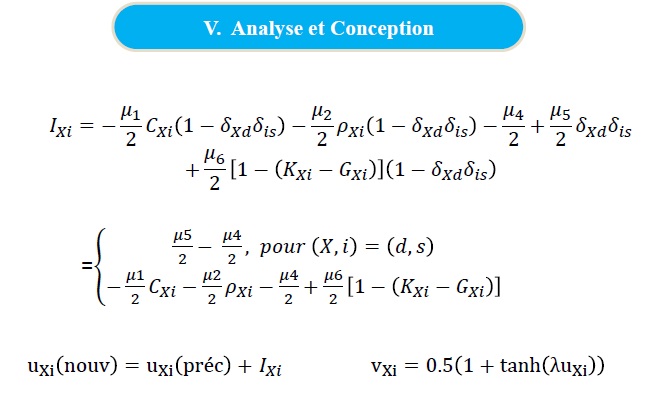
In a first step, the algorithm will run on each router by presenting the cost, the bandwidth and the delay as inputs at each router. Then a summation of the value I will be made on the various inputs at each router. After this summation, the final calculation will allow the activation of a neuron (link) to indicate to the current router which is the best path to reach a given destination.
So taking into account our requirements or constraints the value of the input I will be expressed as follows.
First we will use the same activation function as Hopfield's. The stability of the Liapunov network can be verified by observing the energy function describing the state of the network.
The coefficients C_xi are the costs of linking a router X to a router i.
The term レ_1 minimizes the total cost,
レ_2 prevents non-existent links from being included in the chosen path,
レ_3 is zero for each router in the valid path (the number of incoming links is equal to the number of outgoing links).
レ_4 forces the neural network state to converge to one of the stable states,
レ_5 is equal to zero when the output v_ds is equal to 1. This term is introduced to guarantee that the source and destination routers belong to the solution (the shortest path).
In the end, our input I can be expressed as follows to satisfy all our desired constraints. |
 IEEE/ICACT20220326 Slide.17
[Big Slide]