 |
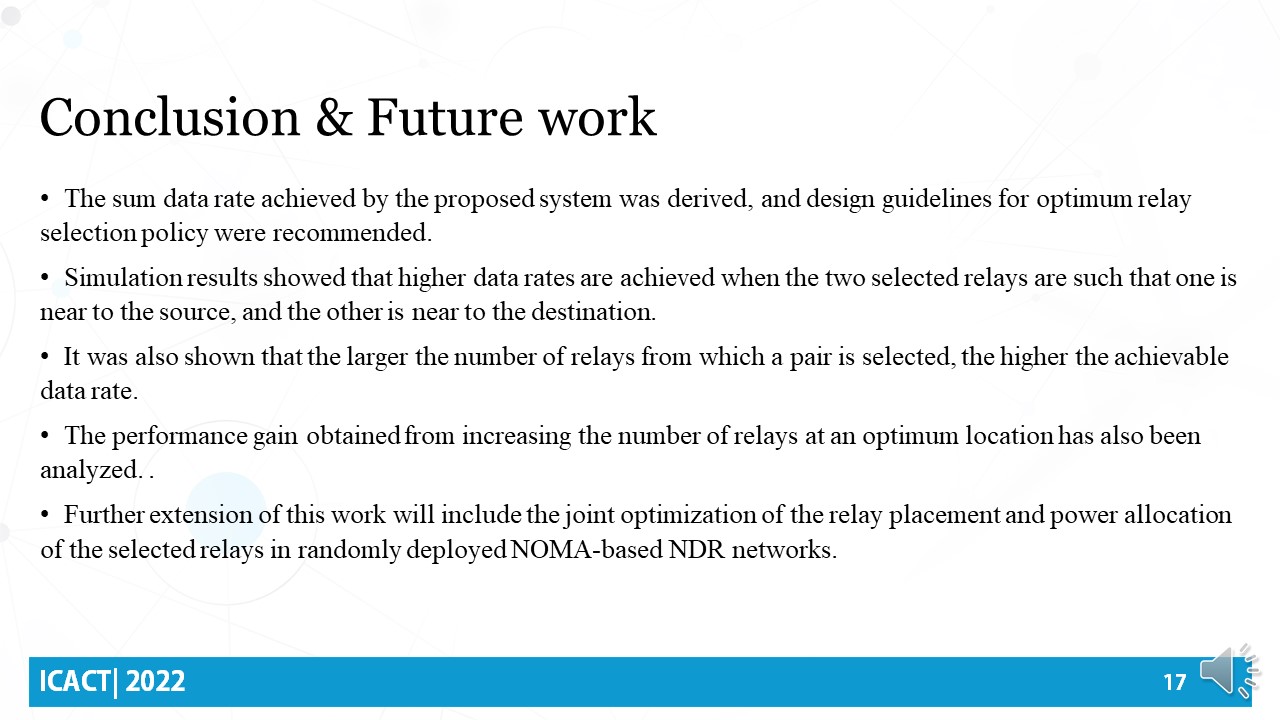
Motivated by the benefits of non-orthogonal multiple access and relay selection, the considered model can result in higher achievable data rates than those achieved by each alone. The sum data rate achieved by the proposed system was derived, and design guidelines for optimum relay selection policy were recommended. Simulation results showed that higher data rates are achieved when the two selected relays are such that one is near to the source, and the other is near to the destination. It was also shown that the larger the number of relays from which a pair is selected, the higher the achievable data rate. It was shown that such gains diminish with a higher number of relays. Further extension of this work will include the joint optimization of the relay placement and power allocation of the selected relays in randomly deployed NOMA-based NDR networks.
|
 IEEE/ICACT20220371 Slide.17
[Big Slide]
[YouTube]
IEEE/ICACT20220371 Slide.17
[Big Slide]
[YouTube]