 |
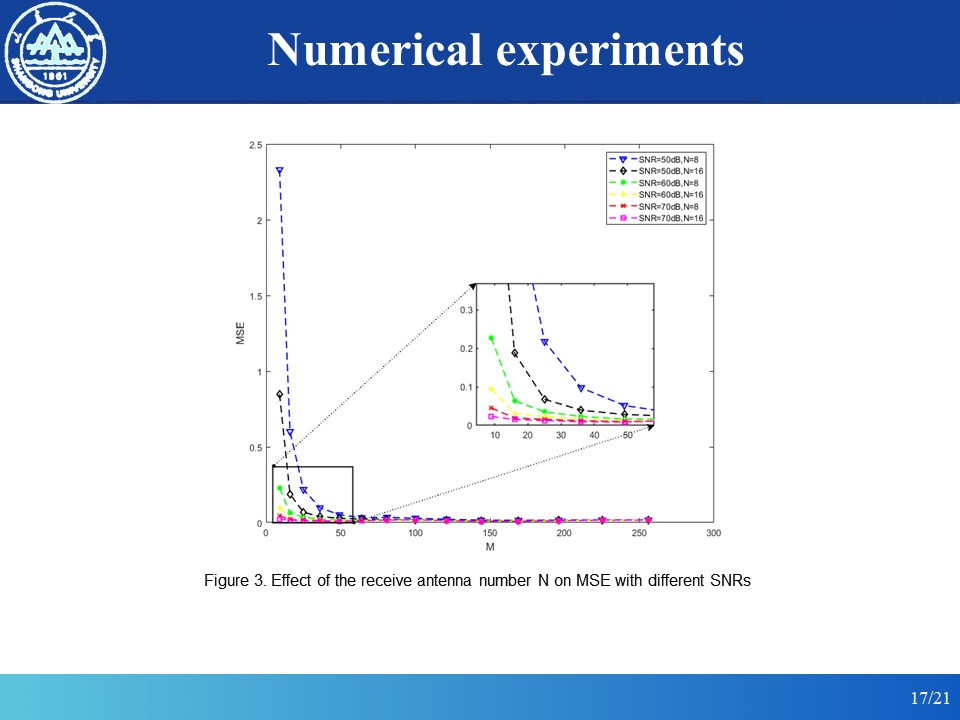
We further study the influence of the number of BS receive antennas on the mean square error (MSE) of positioning with different SNRs. The length of time is L=100. We set SNR=50dB, 60dB, and 70dB, respectively, and the number of BS antennas N=8 and 16, respectively. As seen from Fig. 3, the increasing SNR can significantly improve the positioning performance. That is, the positioning MSE decreases significantly with the increase of SNR since the influence of noise on the positioning error becomes marginal with the increase of SNR. If the SNR increases continuously, the MSE will become very small but not zero even with increasing reflection units of the RISs, which is due to the limitation of the uniform sampling number of angles. When the user is not at the grid points decided by the perception matrix, certain errors will happen and increasing the sampling number can further solve this problem. It is also shown that, when the number of BS receive antennas and the number of RIS reflection units increase, the MSE gradually decreases and then becomes marginal, indicating that the MSE can be affected by both of them, but with limited influence at large number. When the number of RIS units reaches 64, the subsequent MSE changes very little and becomes stable. |
 IEEE/ICACT20240241 Slide.17
[Big Slide]
[YouTube]