 |
Although visible light communication offers attractive security and bandwidth advantages, it also presents significant challenges in terms of range, integration, and environment.
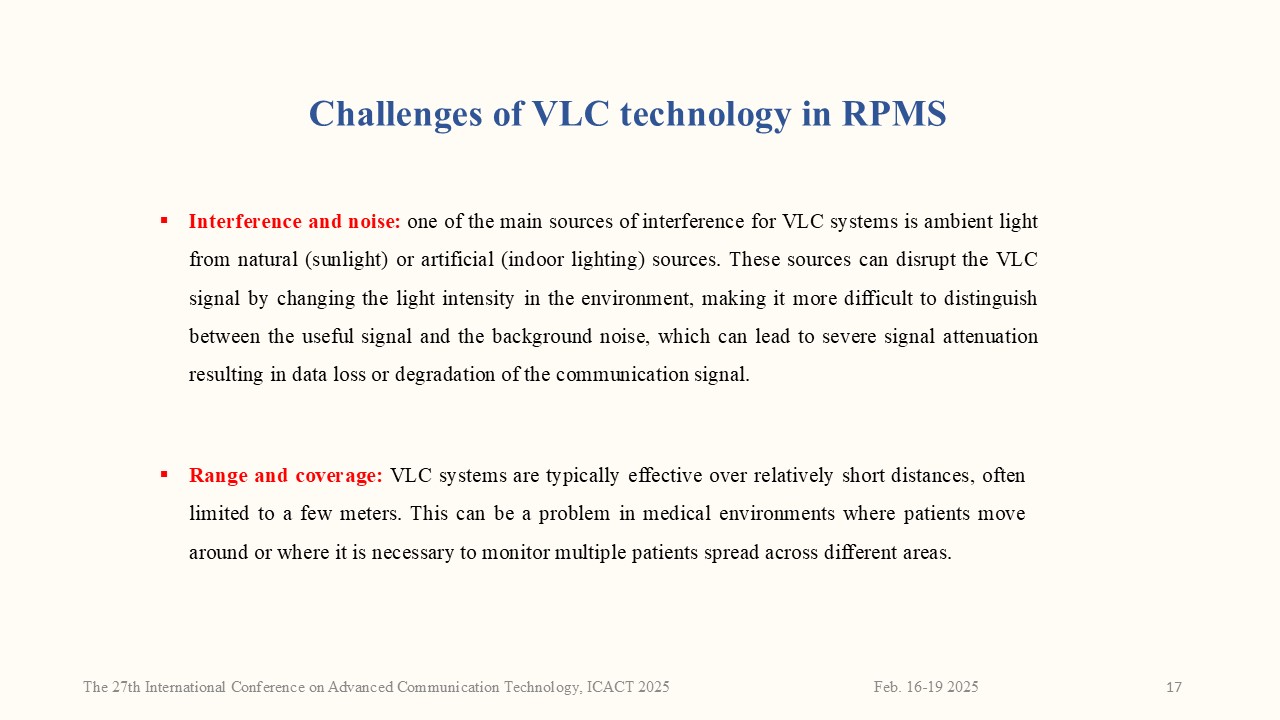
Interference and noise: Interference and background noise represent significant challenges for Visible Light Communication (VLC), especially in remote patient monitoring systems (RPMS), where the transmission of medical data must be reliable and secure. However, one of the main sources of interference for VLC systems is ambient light from natural (sunlight) or artificial (indoor lighting) sources. These sources can disrupt the VLC signal by changing the light intensity in the environment, making it more difficult to distinguish between the useful signal and the background noise, which can lead to severe signal attenuation resulting in data loss or degradation of the communication signal.
Limited range and coverage: VLC systems are typically effective over relatively short distances, often limited to a few meters. This can be a problem in medical environments where patients move around or where it is necessary to monitor multiple patients spread across different areas. The need to maintain a direct line of sight between transmitters and receivers can limit the practical application of VLC in larger or complex environments. Additionally, ambient light sources, such as sunlight or artificial lighting, can create optical noise, which disrupts the reception of light signals. This interference can reduce the reliability and range of communication, requiring adjustments in lighting intensity or the use of filters to attenuate light noise.
|
 IEEE/ICACT20250082 Slide.17
[Big Slide]
[YouTube]