 |
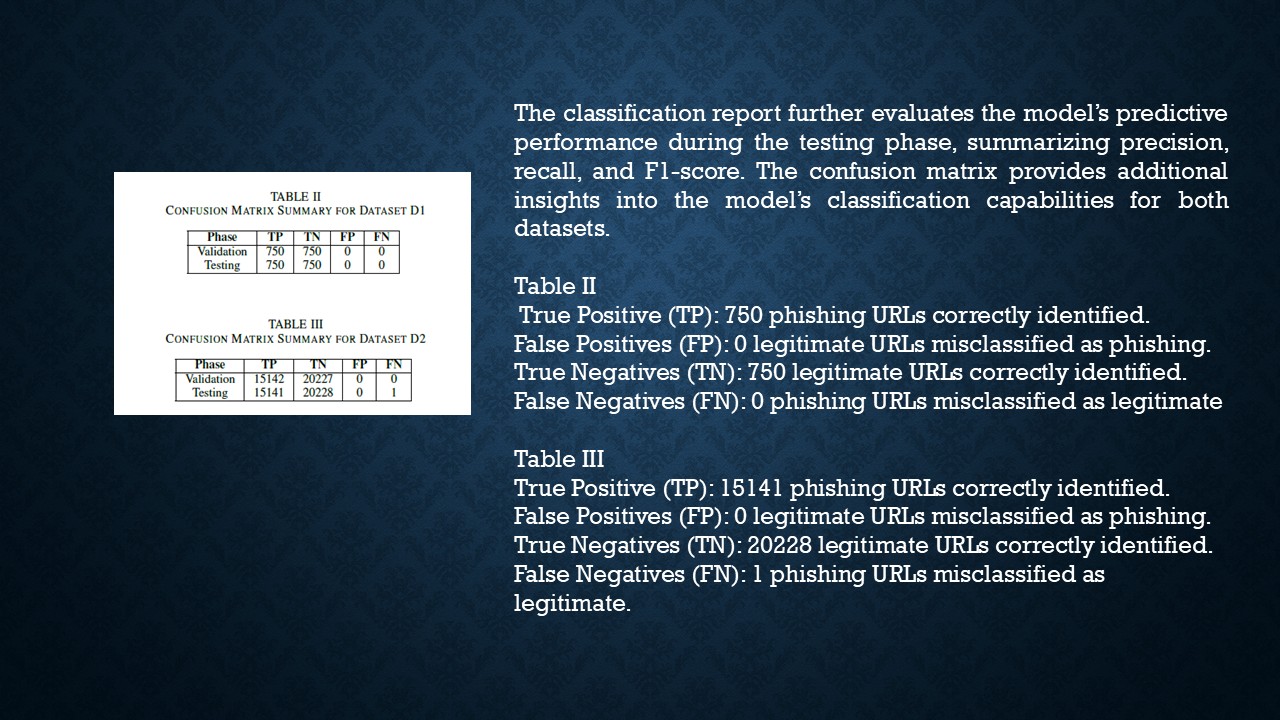
In addition to the confusion matrix, the classification report provides a more detailed evaluation of the model¡¯s predictive performance during the testing phase. It summarizes key performance metrics such as precision, recall, and F1-score, which help us understand how well the model performs in identifying phishing and legitimate URLs. The confusion matrix complements this analysis by providing a detailed breakdown of classification outcomes for both datasets.
For Dataset 1, during both validation and testing phases, the model correctly identified all phishing and legitimate URLs. Specifically, the model achieved 750 true positives and 750 true negatives, with zero false positives and zero false negatives. This indicates perfect detection performance for this dataset.
For Dataset 2, the results were also very strong. During testing, the model correctly identified 15,141 phishing URLs and 20,228 legitimate URLs. There were no false positives, meaning no legitimate websites were incorrectly classified as phishing. Only one phishing URL was misclassified as legitimate, resulting in one false negative.
Overall, these results demonstrate that the proposed model achieves very high detection accuracy while maintaining strong precision and recall performance across different datasets, showing its robustness and reliability for phishing detection tasks. |
 IEEE/ICACT20260061 Slide.17
[Big Slide]