 |
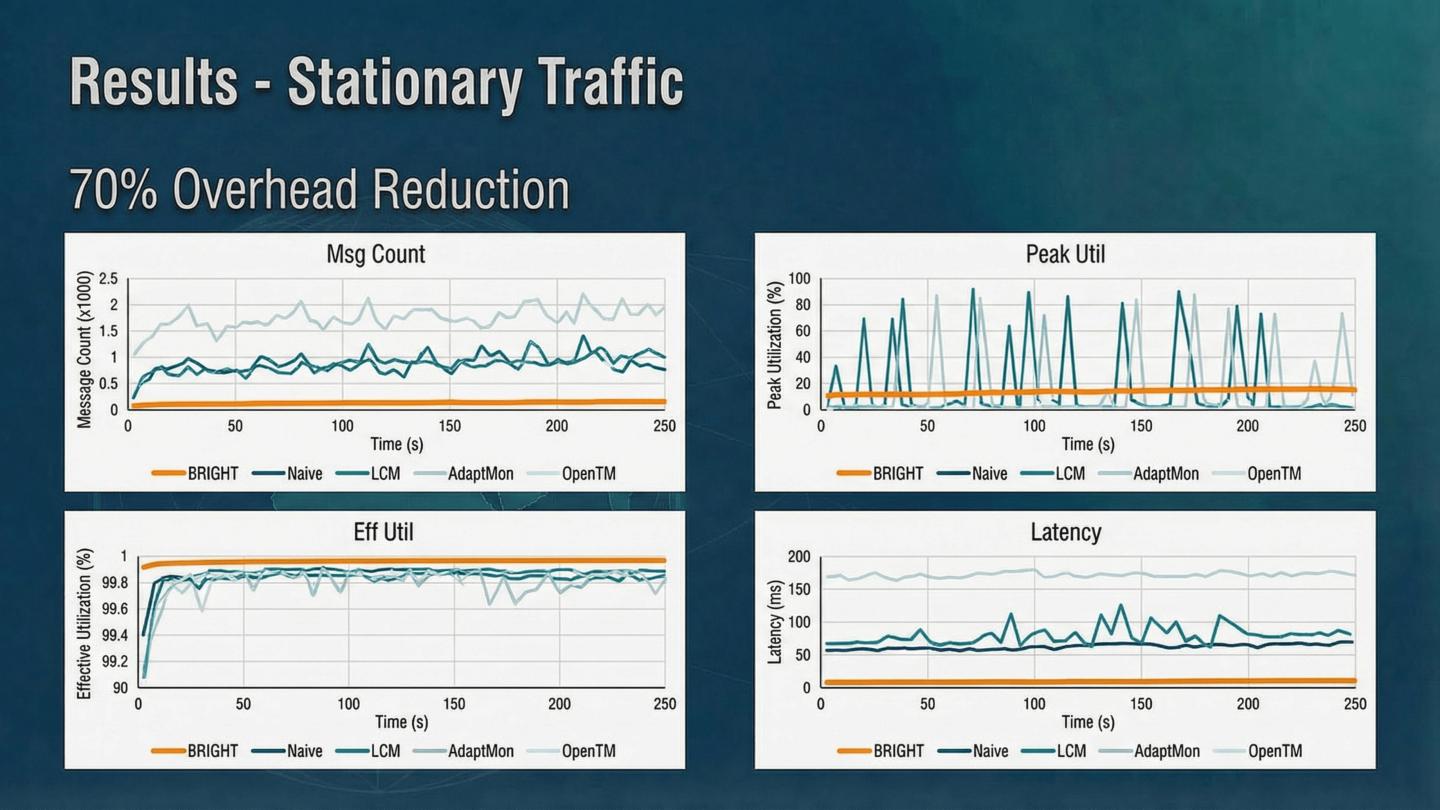
Lets look at the experimental results under stationary traffic conditions. The key takeaway here is that BRIGHT drastically reduces monitoring overhead without sacrificing accuracy. We see that BRIGHT consistently achieves the lowest number of monitoring messages per slot, hovering around 100 messages. This represents a 50 to 70 percent reduction compared to the baselines, which require between 200 and 350 messages. This efficiency gain is directly attributable to our Bayesian uncertainty modeling and the contextual bandit policy, which intelligently selects only the most necessary probes. Furthermore, BRIGHT maintains the highest Effective Link Utilization, near 99.6 percent. This means more network capacity is dedicated to user data rather than measurement overhead. This is a significant gain in large-scale networks. Importantly, our traffic matrix accuracy, measured by RMSE, remains competitive with the baselines. We prove that we can be highly efficient while still providing high-quality measurement data. The control-plane latency is also the lowest and most stable for BRIGHT, indicating that the controller is not being overwhelmed by monitoring requests. These results confirm BRIGHTs ability to operate efficiently in stable environments. But what happens when the network becomes dynamic? Lets look at the bursty traffic results. |
 IEEE/ICACT20260358 Slide.17
[Big Slide]
[YouTube]