 |
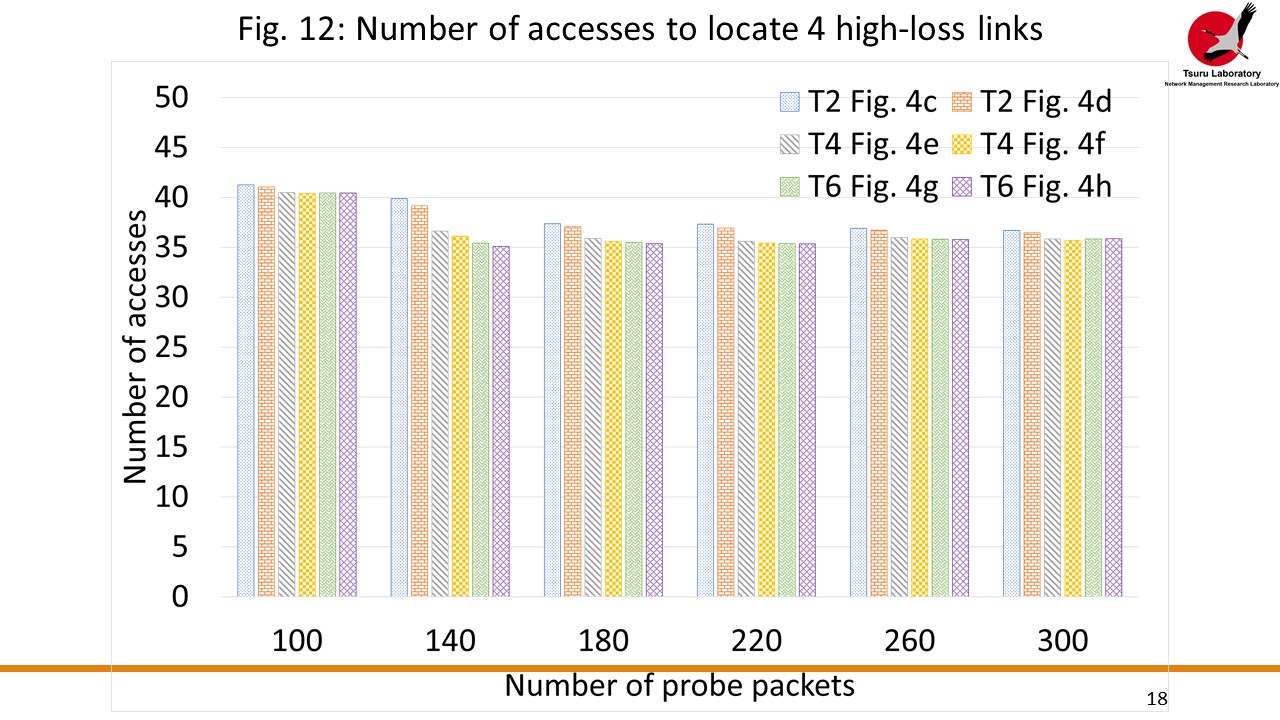
Figure 12 shows the number of the required accesses from OpenFlow controller to OpenFlow switches until the high-loss link location process ends in the case of 4 high-loss links, depending on the number of probe packets.
Note that the results of the location process are not always correct in case that the number of probe packets is less than about 220 for all schemes as shown in Figure 11.
A small number of probe packets needs a more number of accesses probably due to inaccurately measured packet loss rates.
Furthermore, a route scheme with longer terminal paths likely needs more accesses.
This is because an accumulated loss rate over multiple links in a long segment will accidentally exceed the threshold even if the segment does not include any high-loss link, which leads the OpenFlow controller to mistakenly and unnecessarily seek high-loss links in a wrong segment.
Hence our proposed BBT with multiple measurement hosts scheme with shorter terminal paths can reduce the required accesses.
The comparison between single measurement host cases (c,d,e) and multiple measurement hosts cases (f,g,h) in both Figure suggests that the use of multiple MHs with consideration on the locations and their node degrees benefits to realize an acceptably-high measurement accuracy with less number of probe packets and required accesses to OpenFlow switches.
This is because the use of multiple measurement hosts can control the length of terminal paths more flexibly compared with the use of only a single measurement host, although the use of multiple measurement hosts involves additional operational costs.
|
 IEEE/ICACT20210168 Slide.18
[Big Slide]