 |
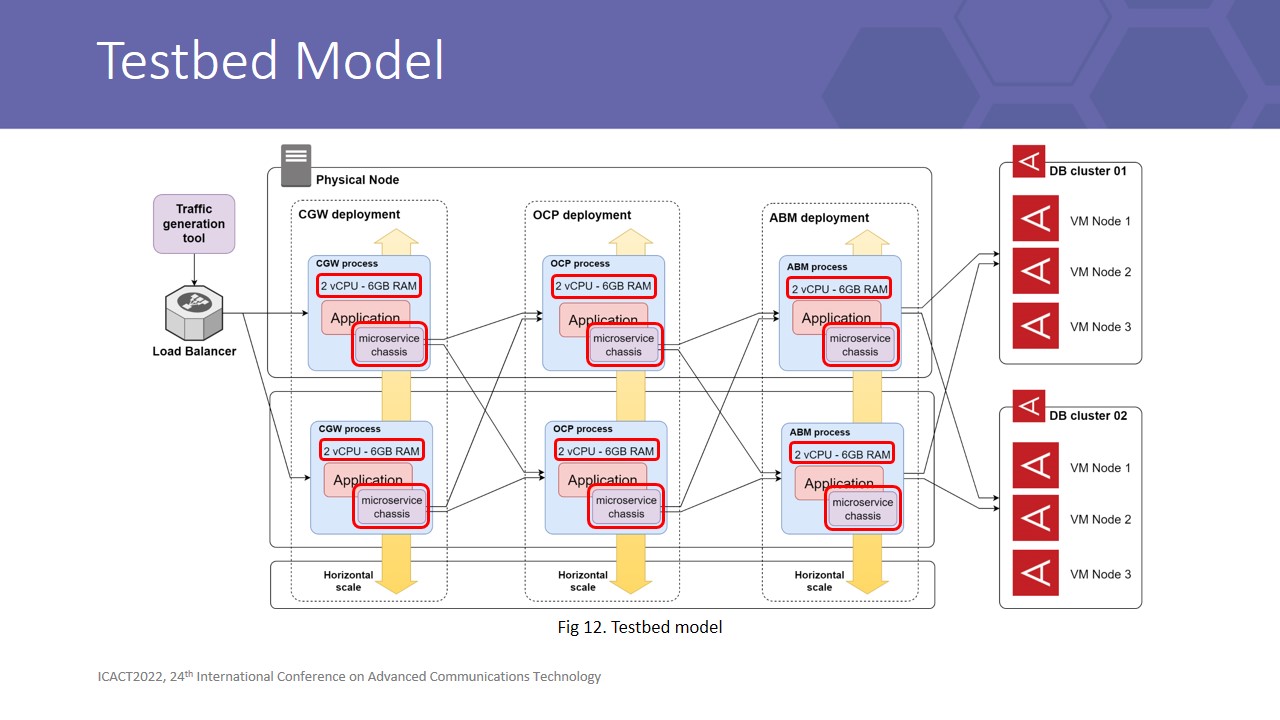
Next, I will talk about another important component, the microservice chassis library. Kubernetes implements the decoupling architecture in which services are separated from each other. The connections between them are established via service discovery as well as an internal Domain Name System (DNS). These network interactions contribute to longer request and response times, as well as higher latency overall. A Service of LoadBalancer type is attached to an Ingress Controller, a set of Ingress that defines where to forward traffic. Each traffic to a service container that passes through the Ingress controller may aggravate the container¡¯s network connectivity overhead. The microservice chassis library alleviates this issue as it lets applications discover the addresses of service containers and connect to them directly. The chassis accommodates scaling by updating the set of container addresses. As a result, network latency should be adequately lessened for telecommunication applications.�Besides, we also apply another technology as CPU pinning to improve the performance of network models. What is CPU pinning ? CPU scheduling algorithms in operating systems usually elect a process to use the CPU at a given time, while the other processes are put on hold. The wait time can accumulate into discernable latency when the operating system has to handle many processes, including application processes or containers. In the case of a heavy workload, the operating system¡¯s native CPU scheduling may jeopardize the performance of 5G Core, whose processes may have their resources temporarily taken away. To fix this problem, CPU-pinning can be used to manually assign a fixed set of CPU cores to a process or a container. The process or container then owns a fixed number of vCPU for its whole lifecycle and no longer has to wait for others. Eliminated wait time is of course conducive to enhanced performance. As you can see, every pod or service in this testbed model uses 2 vCPU and 6 GB RAM.
|
 IEEE/ICACT20220041 Slide.18
[Big Slide]