 |
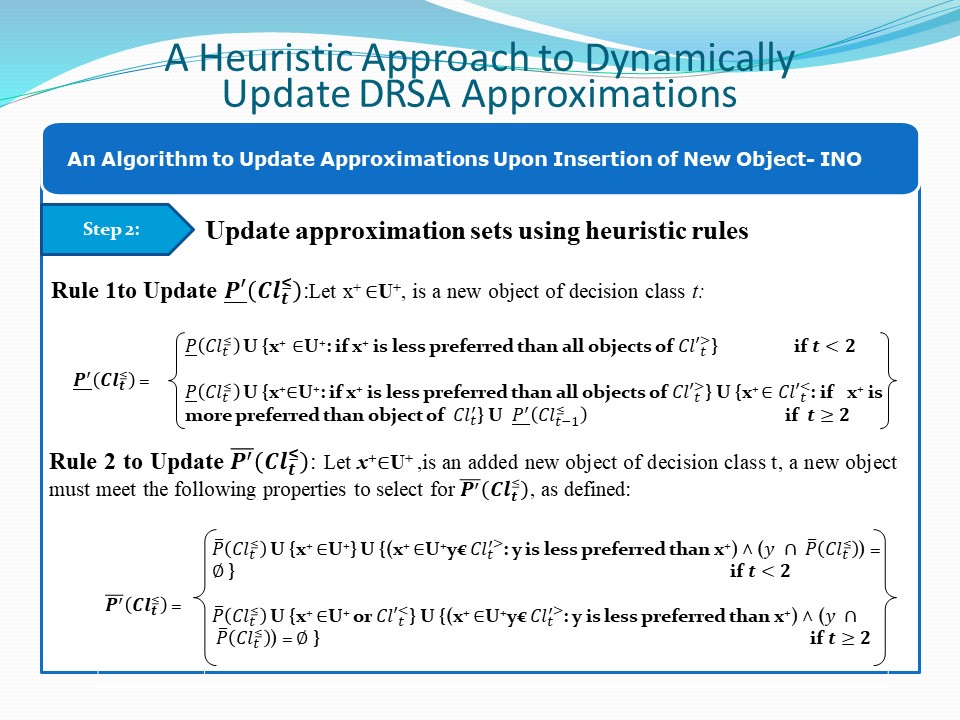
In this algorithm, we update approximations without computing dominance relation and checking subset and intersect properties. We proposed rules, based on the conventional definition and properties of approximations. To update lower approximation for downward union of classes of class ¡®t¡¯, we check if new object belongs to updated decision class ¡®t¡¯ and is less preferred than all objects of more preferred decision classes than class ¡®t¡¯. If ¡®t¡¯ is not lowest class, we check if new object belongs to lower preference ordered class than class ¡®t¡¯ and we check whether new object is more preferred than objects of updated decision class ¡®t¡¯. If ¡®t¡¯ is not lowest class, all objects of lower approximation for downward union of classes of lower preference ordered class than ¡®t¡¯, select for lower approximation for downward union of classes of class ¡®t¡¯ without any computation. To update upper approximation for downward union of classes of class ¡®t¡¯, all new objects of class ¡®t¡¯ and lower preference ordered class than ¡®t¡¯, selects for it without any comparison. We compare new object ¡®x¡¯ of decision class ¡®t¡¯ with object ¡®y¡¯ of more preferred classes than ¡®t¡¯. If object ¡®y¡¯ is less preferred than new object ¡®x¡¯, object ¡®y¡¯ selects for under discussion approximation set.
|
 IEEE/ICACT20220156 Slide.18
[Big Slide]