 |
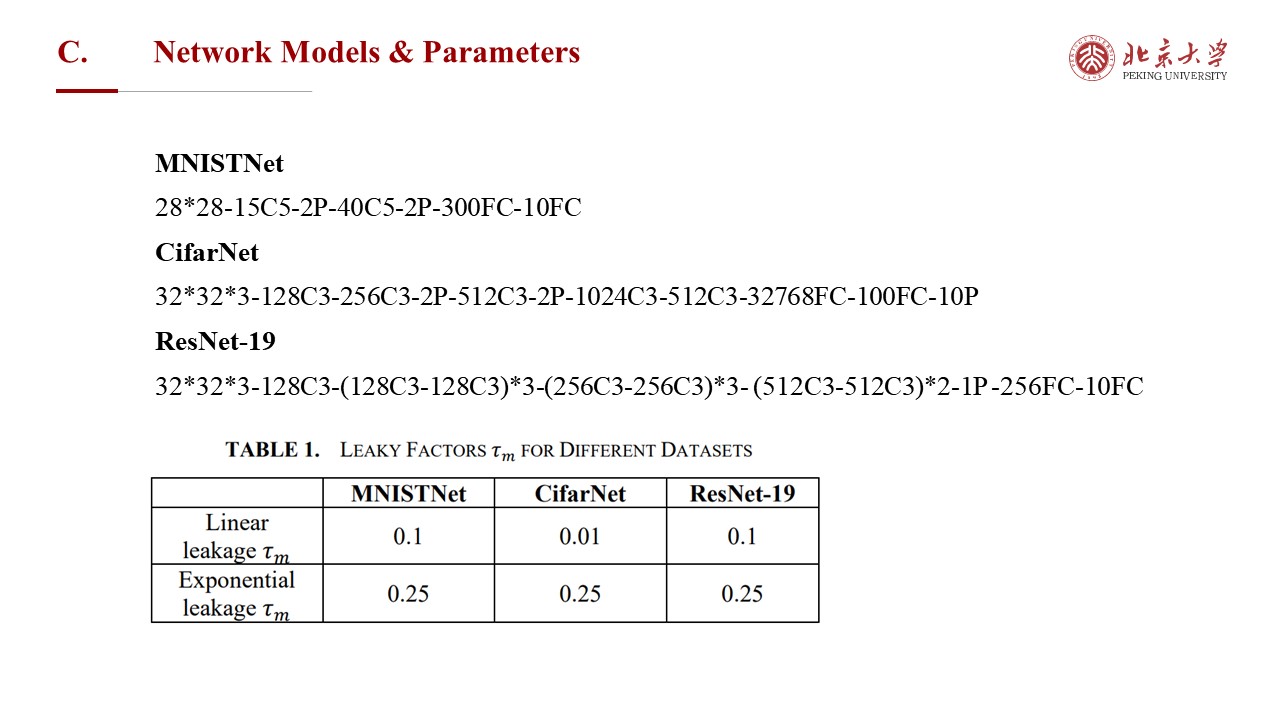
To ensure that the linear leakage approach is robust, we test on the MNIST dataset first. The STBP framework is used in this experiment, and the first convolutional layer is used as the coding layer of the network. The structure of MNISTNet network model we use is represented as (28*28-15C5-2P-40C5-2P-300FC-10FC). Where the input is a 28*28 grayscale map, C5 represents a convolutional layer with a convolutional kernel size of 5*5, 2P represents a mean pooling layer with a kernel of 2*2, and FC represents a fully connected layer. A spiking layer is added to spike the float values after each layer.
We conduct the experiments on the Cifar10 dataset to demonstrate the generalization of linear leakage robustness.The structure of CifarNet model can be shown as (32*32*3-128C3-256C3-2P-512C3-2P-1024C3-512C3-32768FC-100FC-10P). Where the input is a 32*32 color map, C3 represents a convolutional layer with a convolutional kernel size of 3*3, 10P represents a one-dimensional average pooling layer with a kernel of 10*10 and a padding of 10 and FC represents a fully connected layer. Each convolutional layer is followed by the tdBN layer [2]. After each network layer, a spiking layer is added to spike the float values.
The structure of ResNet-19 model can be shown as [32*32*3-128C3-(128C3-128C3)*3-(256C3-256C3)*3-(512C3-512C3)*2-1P -256FC-10FC]. Where the input is a 32*32 color map, C3 represents a convolutional layer with a convolutional kernel size of 3*3, the brackets represent a residual block, 1P represents a two-dimensional average pooling layer with a kernel of 1*1 and a padding of 1, and FC represents a fully-connected layer. An spiking layer is added after the last fully connected layer.
In this experiment, we uniformly used the parameters: Timestep = 2, 𝑈_𝑡ℎ =0.2, 𝑈_𝑚𝑒𝑚 =0.9. Table 1 shows the specific leaky factors of different leaky methods for different datasets. In order to prevent the phenomenon of overfitting of different leaky methods trained in the model, in this paper, the network model weights of each leakage method are trained to the same accuracy and then the experimental data are saved and tested with a noisy dataset. Among them, the accuracy of MNISTNet is 99%, CifarNet is 80%, and ReaNet-19 is 85%.
|
 IEEE/ICACT20230030 Slide.18
[Big Slide]