 |
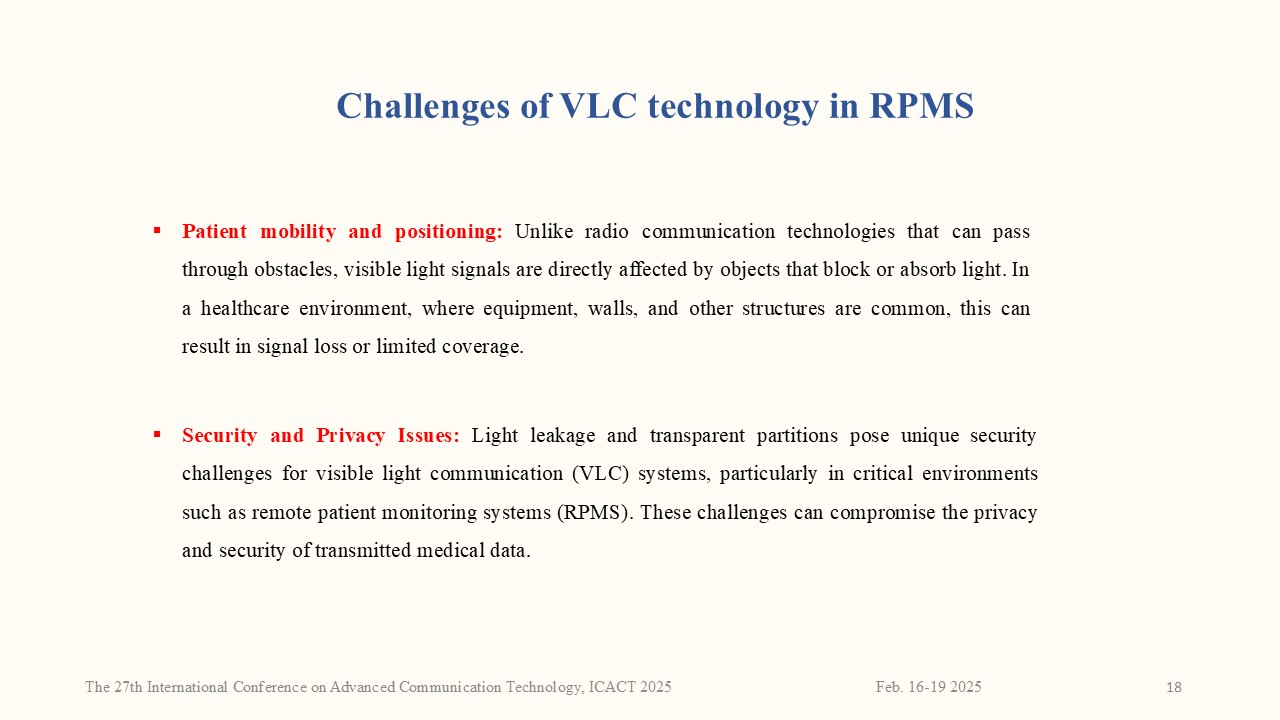
Patient mobility and positioning: Unlike radio communication technologies that can pass through obstacles, visible light signals are directly affected by objects that block or absorb light. In a healthcare environment, where equipment, walls, and other structures are common, this can result in signal loss or limited coverage. As a result, patients may move around their room or between rooms, which can interrupt communication if the VLC sensor is unable to track their movement. Monitoring devices must therefore be designed to accommodate these movements, either by using multiple transmitters and receivers or by integrating complementary technologies to ensure continuous coverage.
Security and Privacy Issues: Light leakage and transparent partitions pose unique security challenges for visible light communication (VLC) systems, especially in critical environments such as remote patient monitoring systems (RPMS). These challenges can compromise the privacy and security of transmitted medical data [37]. Unlike radio waves, visible light does not pass through walls, but it can propagate through openings or windows allowing an outside observer to intercept the data. This light leakage can lead to unauthorized interceptions if the VLC system is operating in a poorly insulated space. However, medical monitoring systems often rely on continuous transmissions of sensitive data, such as real-time health measurements. Transparent partitions could therefore compromise the confidentiality of this information, even in supposedly secure environments, such as consulting rooms or patient rooms.
|
 IEEE/ICACT20250082 Slide.18
[Big Slide]
[YouTube]