 |
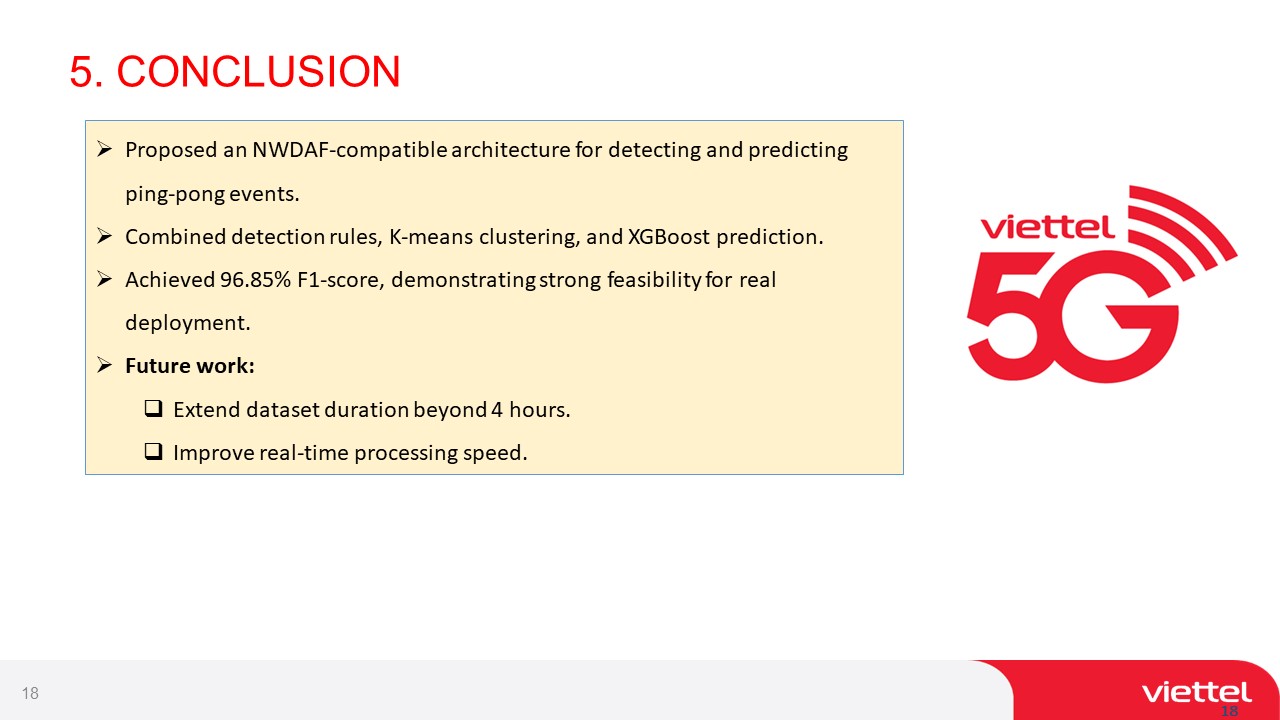
In conclusion, our research proposes an NWDAF-compatible architecture for detecting and predicting ping-pong events in 5G networks. The key takeaways are:
We combine detection rules, K-means clustering, and XGBoost prediction into a comprehensive solution. This multi-pronged approach leverages the strengths of each technique.
Our best model, XGBoost, achieves an impressive 96.85% F1-score on the test set. This demonstrates the feasibility and effectiveness of ML-driven ping-pong mitigation.
Critically, we show how this predictive system can integrate seamlessly into the 5G NWDAF workflow. By embedding intelligence into the handover process, we enable proactive optimization.
Looking ahead, we plan to extend the data collection duration beyond 4 hours to capture a wider range of network conditions. We also aim to improve real-time processing speed to ensure the system can keep pace with the millisecond-level demands of 5G.
Overall, this work represents a significant step towards self-optimizing, intelligent 5G networks. By harnessing the power of big data and machine learning, we can deliver a new level of service continuity and user experience. |
 IEEE/ICACT20260091 Slide.18
[Big Slide]