 |
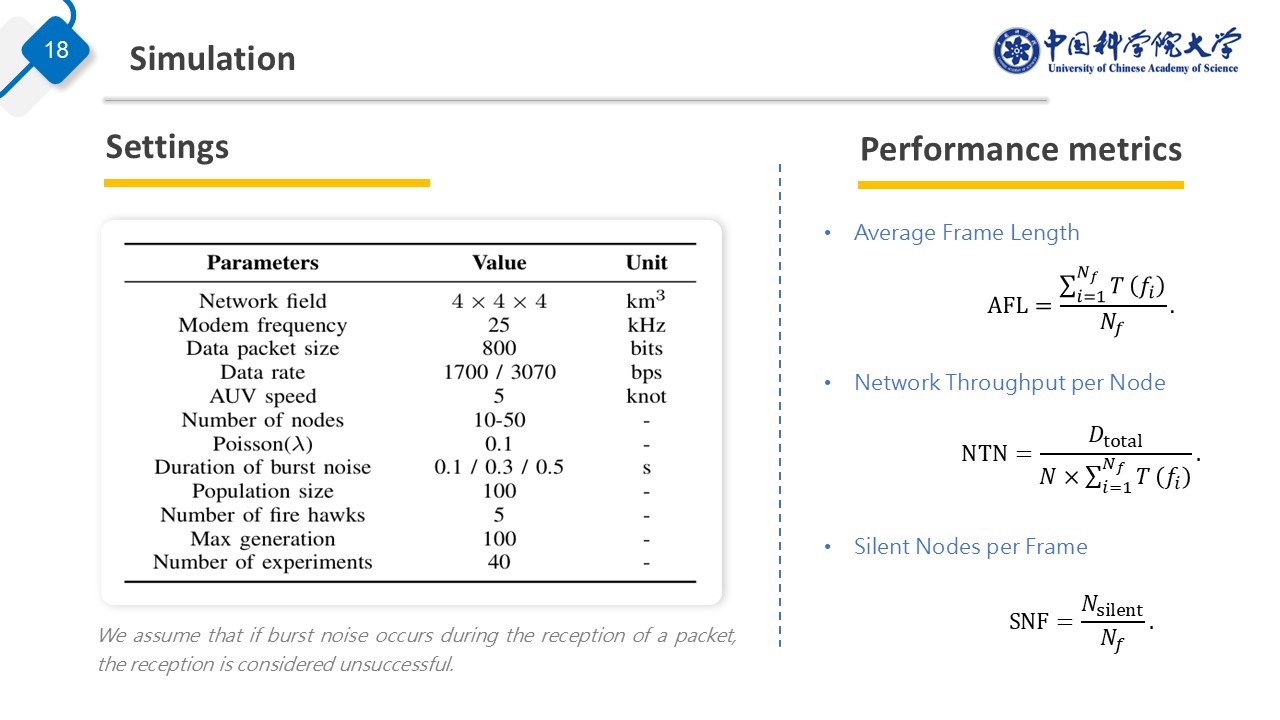
We evaluate the performance of proposed FRAB-MAC, AB-MAC and conventional centralized TDMA (C-TDMA) protocols with MATLAB in this part. The AUV nodes are randomly deployed within a 3D underwater area of four by four by four cubic kilometers and maintain the initial random formation while moving linearly at a speed of 5 knots. In addition to ambient noise, burst noise is also considered in the simulation to evaluate its impact on data packet transmission and reception. Burst noise is assumed to obey a Poisson distribution with parameter lambda which indicates the frequency of noise events. We assume that if burst noise occurs during the reception of a packet, the reception is considered unsuccessful. For a fair comparison, both the genetic algorithm and the FHO are initialized with a population size of 100 and run for up to 100 generations. To ensure the robustness of the results, 40 independent trials were conducted for each network size and node density.
Three key metrics are considered in the simulations to compare the performance of different MAC protocols. The first metric is the average frame length, defined as the mean duration of a TDMA cycle, i.e., the sum of all node time slots, measured in seconds. The second metric is the average throughput per node, defined as the ratio of the total amount of data received by all nodes to the product of the simulation duration and the number of nodes. This metric is considered the most critical indicator of MAC protocol performance. Third, the average number of silent nodes per frame, which reflects whether the optimized transmission sequence can reliably guarantee that every node has successfully received the broadcast control packet. |
 IEEE/ICACT20260317 Slide.18
[Big Slide]
[YouTube]