 |
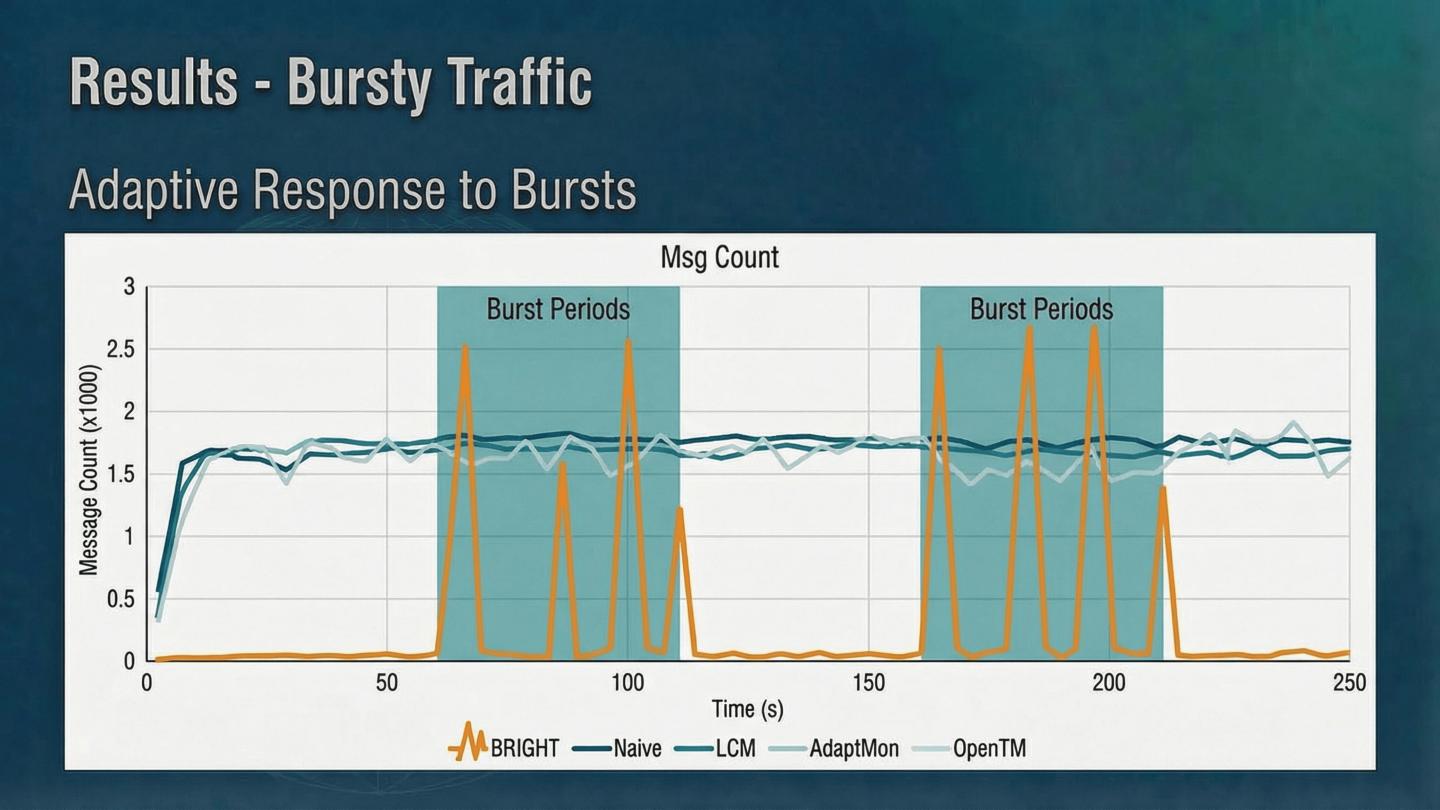
Lets look at how BRIGHT performs under bursty traffic, which is a much more challenging scenario. We introduced random traffic bursts to 30 percent of the flows, simulating real-world network dynamics. The core challenge is adapting quickly to these bursts without over-provisioning the monitoring system. The results show BRIGHTs superior adaptability. During burst intervals, BRIGHT correctly identifies the increased uncertainty and moderately increases its probing rate. However, even during these peaks, our monitoring message count remains significantly lower than all baselines. This demonstrates that the contextual bandit policy is successfully learning to increase measurement intensity only when and where it is needed. Crucially, BRIGHT quickly returns to a low overhead state once the burst subsides, unlike the baselines which tend to maintain persistently high probing rates. This adaptive behavior is key to long-term efficiency. We also observe that BRIGHT maintains the highest Effective Link Utilization throughout the experiment, even during the bursts. This means our system preserves data traffic capacity when the network is under stress. Finally, BRIGHT exhibits the smallest and most stable control-plane latency, preventing controller congestion even when the traffic is highly dynamic. These results validate the power of integrating Bayesian uncertainty with reinforcement learning for dynamic resource allocation. This leads us to the key insights derived from our design and evaluation. |
 IEEE/ICACT20260358 Slide.18
[Big Slide]
[YouTube]