 |
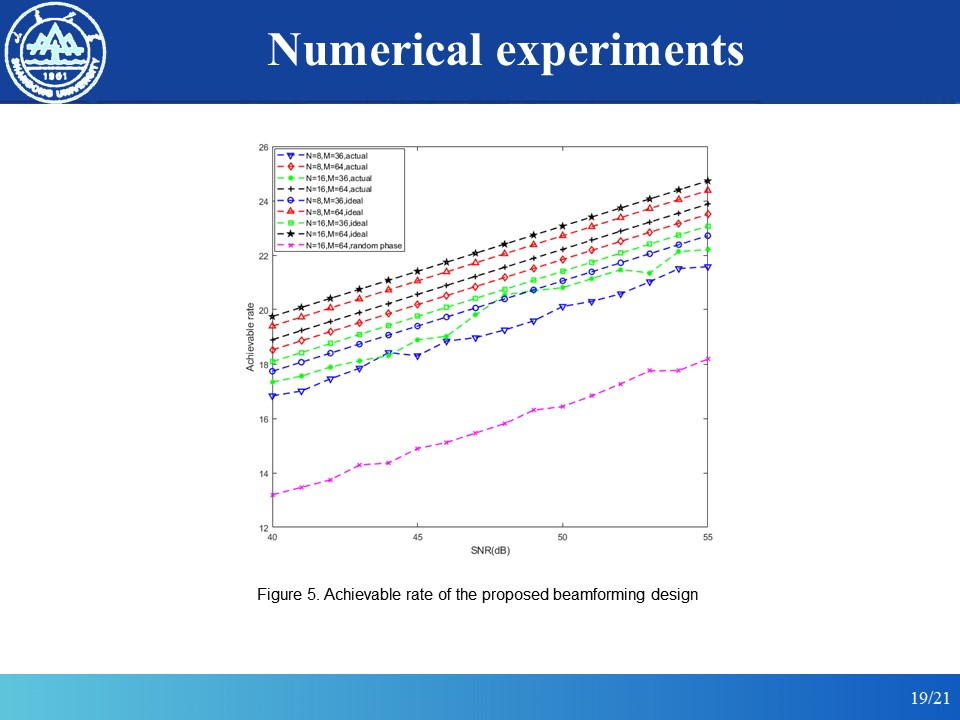
In the following, we study the TI-AO algorithm based beamforming design of the BS antennas and the RIS units according to the obtained positioning information. The system achievable rate with the proposed beamforming design is shown in Fig. 5. We set the uniform sampling number as 2000, the number of BS antennas as 8 and 16, and the number of RIS units as 36 and 64, respectively. The random phase shifts of RIS are also considered for comparison. It is shown that the increase of the SNR, the number of BS antennas, and the number of RIS units, will improve the system achievable rate. At the same time, it is found that, when the number of RIS units is small, the system achievable rate does not increase linearly with the increased SNR due to the large positioning MSE at the first stage shown in Fig. 3. However, when the number of RIS units is 64, the achievable system rate increases linearly with the SNR. |
 IEEE/ICACT20240241 Slide.19
[Big Slide]
[YouTube]