 |
ow, how do we compute trust?
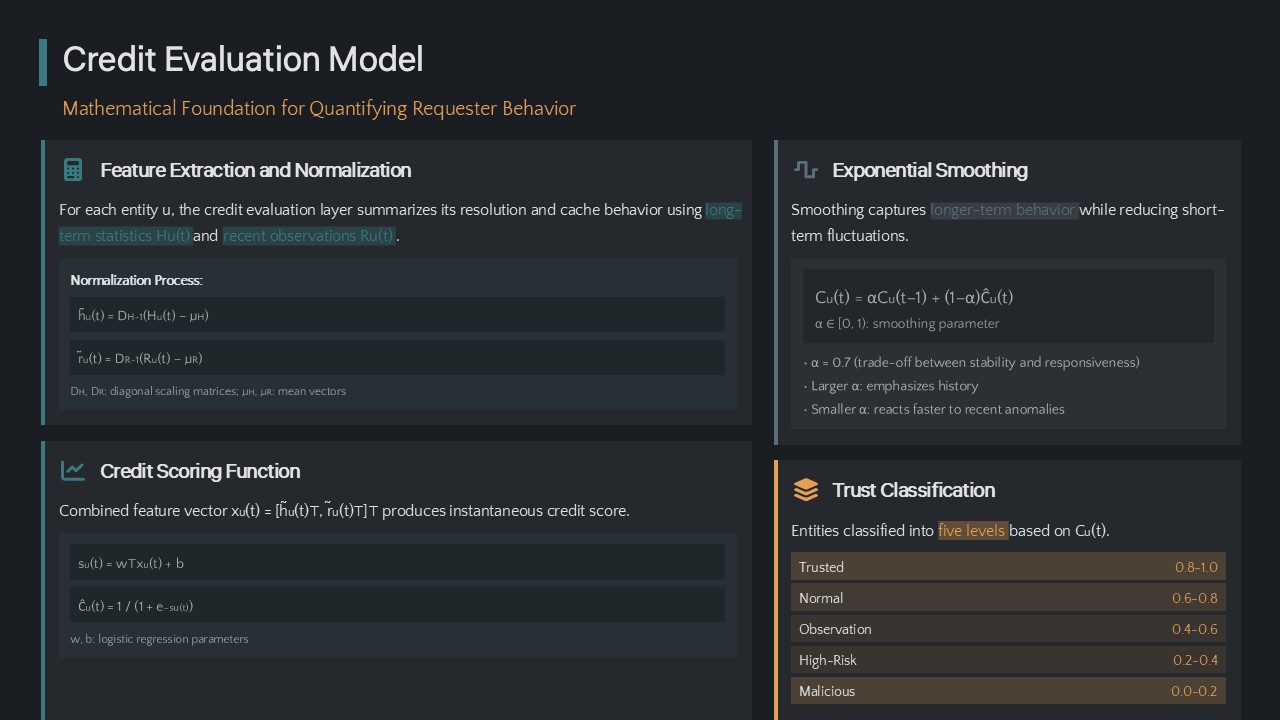
For each entity u, at an edge node we summarize behavior over time using two categories of features: long-term statistics and recent observations, derived from resolution and cache behavior within a sliding window.
We normalize features and form a combined feature vector. Then we use a linear scoring function, followed by a logistic transform to obtain an instantaneous credit.
To smooth short-term fluctuations and capture longer-term behavior, we apply exponential smoothing, where alpha is 0.7 to balance stability and responsiveness.
Finally, we map credit into five trust levels: trusted, normal, under observation, high-risk, and malicious.
Intuitively, if a DID consistently exhibits low resolution success or low cache hit behavior—patterns consistent with pollution or exhaustion—its credit will drop, and policy enforcement will progressively restrict it. |
 IEEE/ICACT20260343 Slide.19
[Big Slide]
[YouTube]