 |
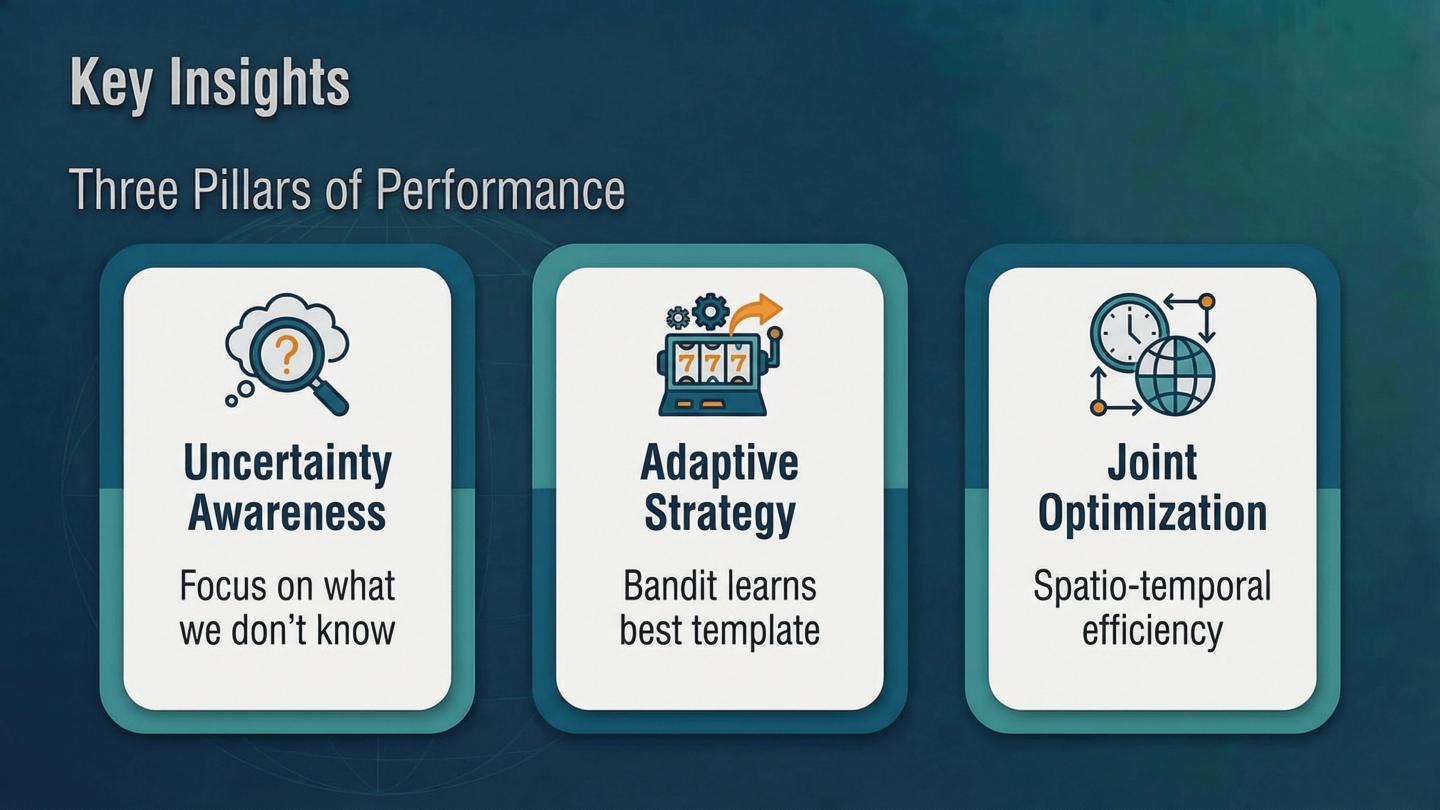
Lets look at the key insights that drove the design of BRIGHT and explain why our approach is so effective. The fundamental insight is that network monitoring should be treated as a sequential decision problem under uncertainty, not a static optimization. This led us to three core design choices. First, the Bayesian Flow State Estimation is critical because it provides a principled way to quantify uncertainty. By modeling the variance of a flows rate, we can prioritize monitoring resources on flows that are difficult to estimate, rather than just the largest flows. This is a fundamental shift from rate-based heuristics. Second, the Contextual Bandit Policy Learning allows the system to automatically learn the optimal monitoring strategy. We dont rely on manual tuning of parameters. The system learns which template—aggressive or conservative—works best given the current network state and its associated cost and accuracy trade-offs. This provides the necessary adaptability. Third, the Spatio-Temporal Probing Scheduler ensures that the selected monitoring budget is executed with maximum efficiency. By jointly optimizing when to probe a flow and which switch along its path to query, we minimize the total control-plane cost and balance the load across the network. These three components work in concert to achieve the high efficiency and accuracy we observed in the experiments. Now, lets summarize the overall impact of this work. |
 IEEE/ICACT20260358 Slide.19
[Big Slide]
[YouTube]