 |
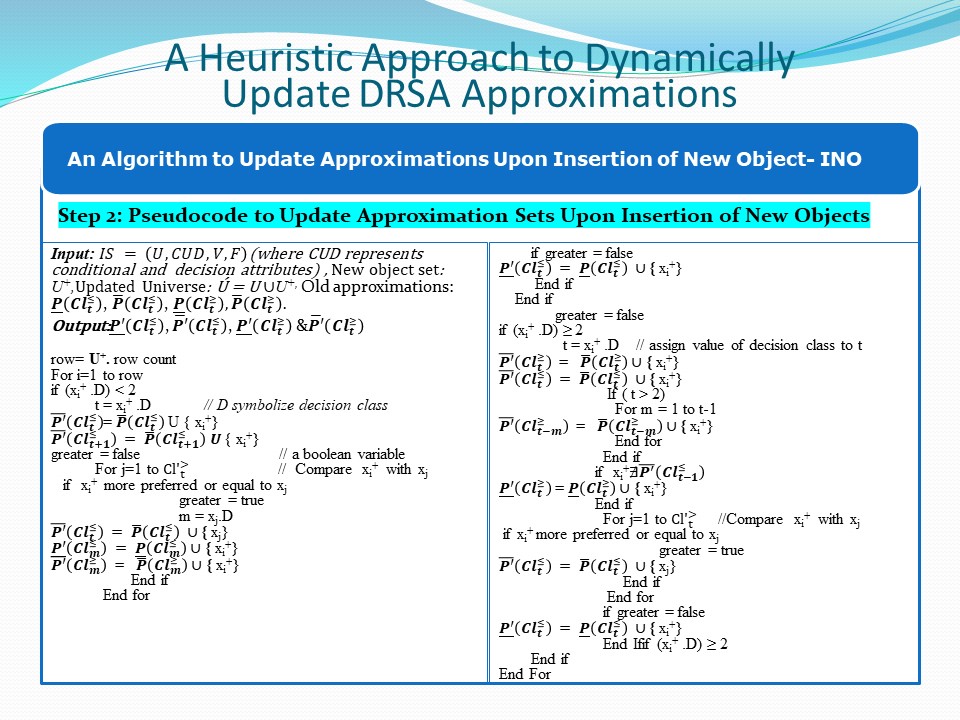
Here is the pseudocode to update approximations using rules, defined earlier. As an input we have old approximation sets, new object set and updated dataset. We start with the first object of new object set, if class of new object is lowest class (𝒕<𝟐), object selects for upper approximation for downward union of classes of class ¡®t¡¯ without computation. Simultaneously, object selects for upper approximation for downward union of classes of more preferred class than class ¡®t¡¯ (t+1). Then we compare new object with objects of more preferred class than ¡®t¡¯ for all its conditional attributes, if new object is more preferred, select new object for upper approximation for downward union of classes of class ¡®t¡¯ and simultaneously for lower approximation for downward union of classes of class ¡®t¡¯ and upper approximation for upward union of classes of class ¡®t¡¯. If new object is less preferred, then object selects for lower approximation for downward union of classes of class ¡®t¡¯. If new object does not belong to lowest class, then algorithm update approximations using defined rules for ¡®𝒕¡Ã𝟐¡¯ and avoid redundant computations.
|
 IEEE/ICACT20220156 Slide.20
[Big Slide]