 |
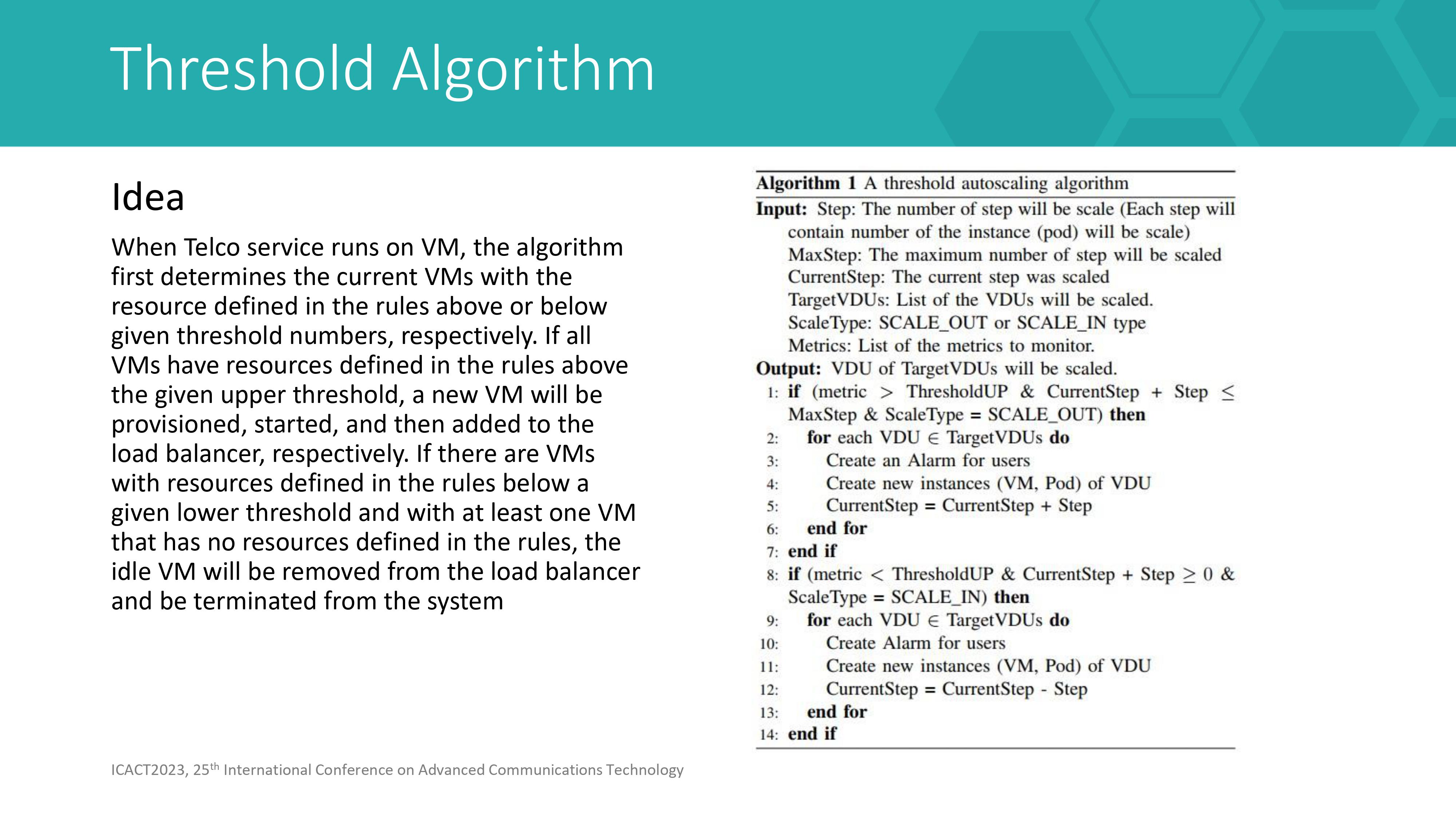
With a defined threshold, we illustrate our auto-scaling algorithm on Algorithm 1. When Telco service runs on VM, the algorithm first determines the current VMs with the resource defined in the rules above or below given threshold numbers, respectively. If all VMs have resources defined in the rules above the given upper threshold, a new VM will be provisioned, started, and then added to the load balancer, respectively. If there are VMs with resources defined in the rules below a given lower threshold and with at least one VM that has no resources defined in the rules, the idle VM will be removed from the load balancer and be terminated from the system. For Telco services running on Pod Kubernetes, with the rule defined (maybe about physical computing resources such as the uses of CPU and memory) will be indices for the evolution of the workload of a virtual cluster. When Telco applications run on Pod Kubernetes, the algorithm first determines the current Pods with the use of physical resources above or below given threshold numbers. If the uses of resources of all Pods are above the given upper threshold, a new Pod will be created, provisioned, started, and then perform the same computing tasks in the virtual cluster. If the uses of resources of some Pods are below a given lower threshold and with at least one Pod that has no computing job, the idle Pod will be terminated from the virtual cluster. |
 IEEE/ICACT20230145 Slide.20
[Big Slide]