 |
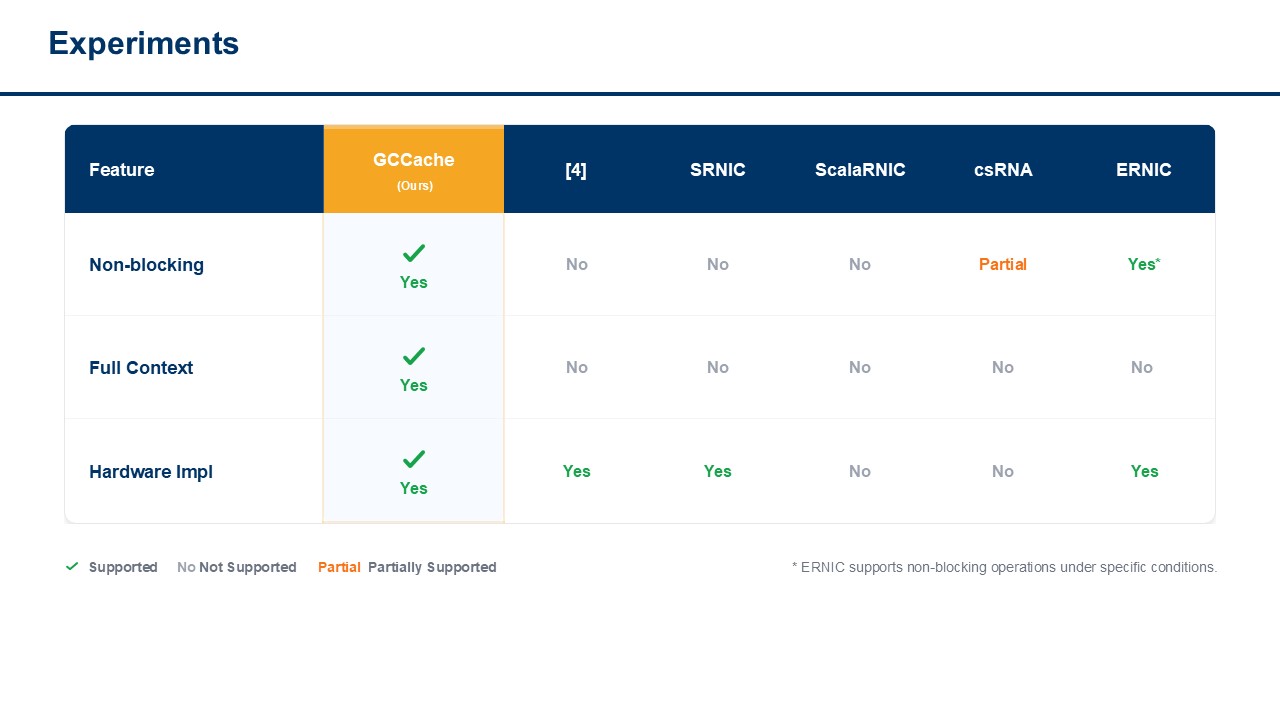
Finally, let me present a functional comparison between GCCache and existing designs. This table summarizes the key differentiating features.
We evaluate along three dimensions:
First, Non-blocking support. GCCache provides full non-blocking support through our deduplication and outstanding manager mechanisms.
SRNIC and ScalaRNIC do not support non-blocking access at all.
csRNA only partially addresses this.
ERNIC technically avoids blocking, but only by storing all context on-chip, which severely limits scalability to just a few hundred QPs.
Second, Full Context support. GCCache supports caching for all five context types. In contrast, all prior works support only a subset of these context types. This means they cannot provide a complete solution for real-world RDMA workloads that require all these metadata structures.
Third, Hardware Implementation. GCCache has been fully implemented in hardware on a Xilinx U200 FPGA. ScalaRNIC and csRNA were only evaluated in simulation.
As you can see, GCCache is the only design that achieves all three checkmarks: full non-blocking support, complete context type coverage, and validated hardware implementation. This makes it a comprehensive and practical solution for high-performance RDMA NICs. |
 IEEE/ICACT20260320 Slide.21
[Big Slide]
[YouTube]