 |
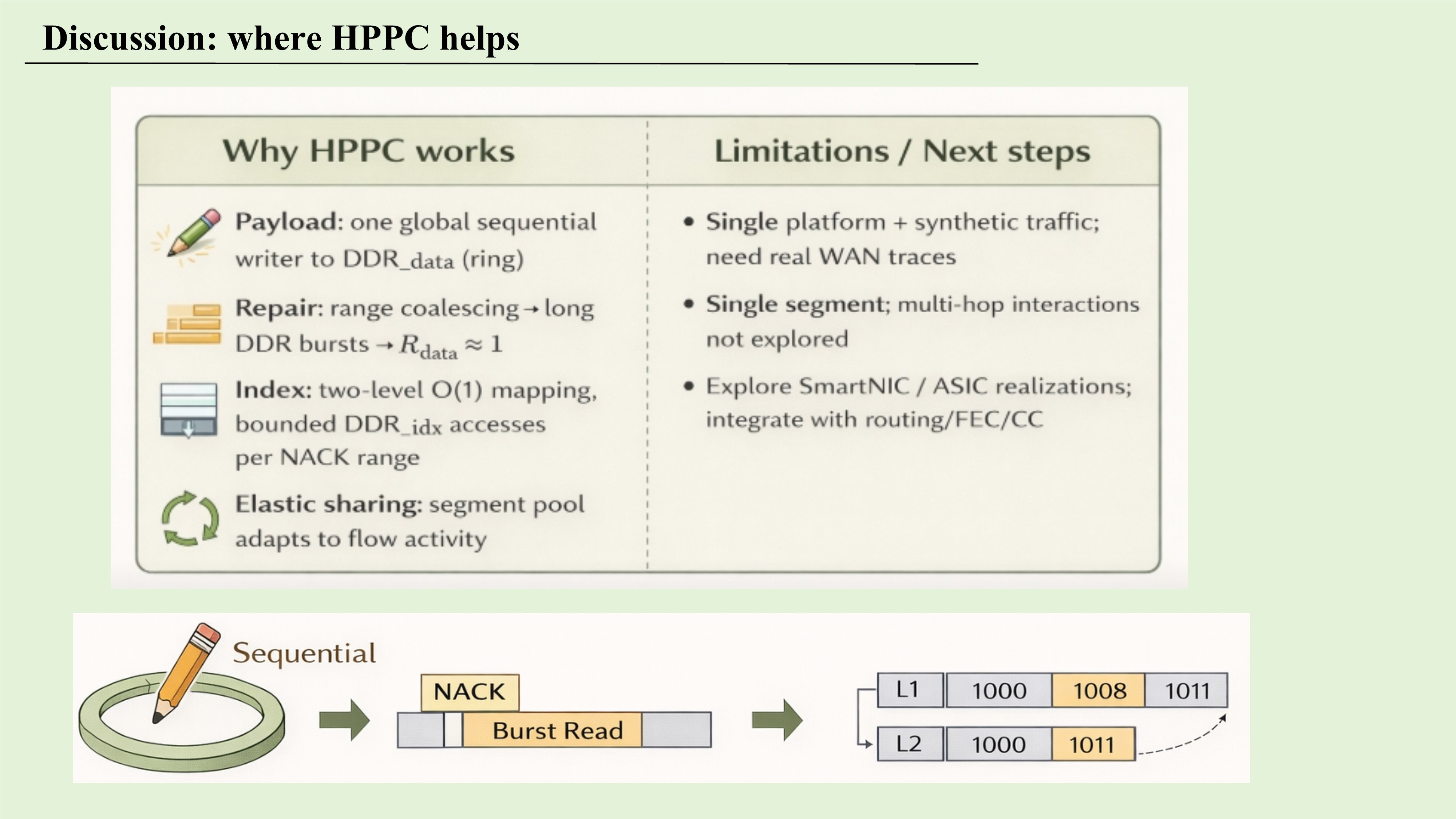
We acknowledge several limitations. Our experiments use synthetic CBR traffic and independent random loss; real WAN traces may involve correlated losses, burstiness, flow churn, and mixed packet sizes, which could stress NACK coalescing and segment pool management differently. We evaluate a single HPPC segment and do not explore multi-hop deployments or interactions across segments. Comparisons to P4 and SR-NIC designs rely on published results as qualitative references rather than head-to-head tests on identical hardware. Nevertheless, the evaluation demonstrates the structural advantage of the ring-plus-two-level index design in achieving DDR-friendly sequential access at line rate. |
 IEEE/ICACT20260323 Slide.21
[Big Slide]
[YouTube]