 |
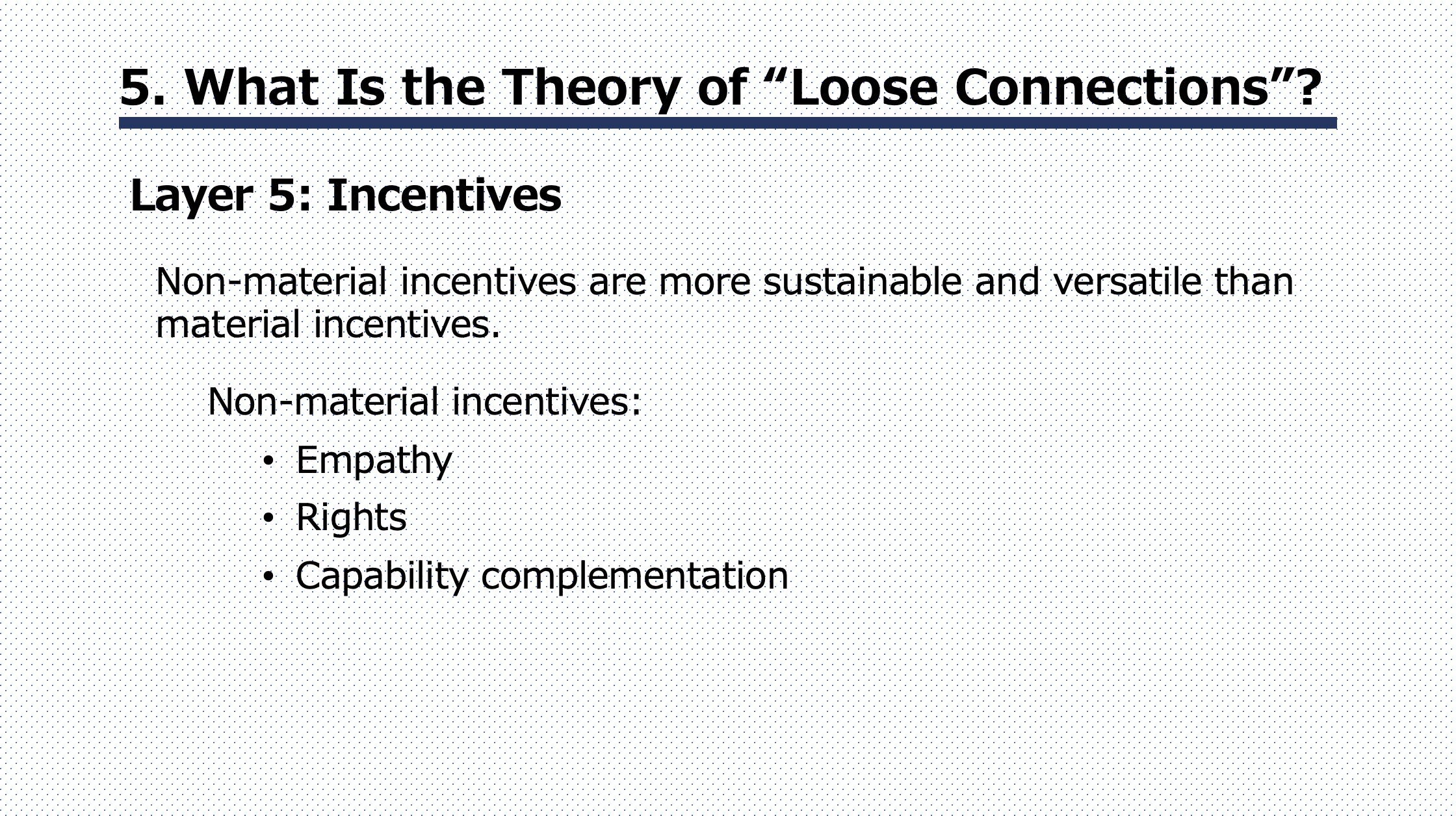
Layer 5 focuses on incentives that motivate participation and sustained engagement. In the context of loose connections, non-material incentives are more sustainable and adaptable than material incentives. These non-material incentives include empathy, rights, and capability complementation. The first incentive is empathy. When actors share empathy toward a concept or vision, they connect not for external rewards, but for shared meaning. This enables low-cost yet highly effective connections. As discussed in Layer 3, concepts have longer lifetimes than material properties, which makes empathy-based incentives more sustainable. The second incentive is rights. Granting rights, such as decision-making authority or participation opportunities, fosters actorsĄŻ autonomy. These rights support brokerless connections, as discussed in Layer 2. Without such rights, connections tend to become actor-dependent and high-cost. The third incentive is capability complementation. Actors are motivated to connect by complementing each otherĄŻs capabilities. For example, a virtual supercomputer achieves high performance by interconnecting distributed resources. |
 IEEE/ICACT20260157 Slide.22
[Big Slide]